


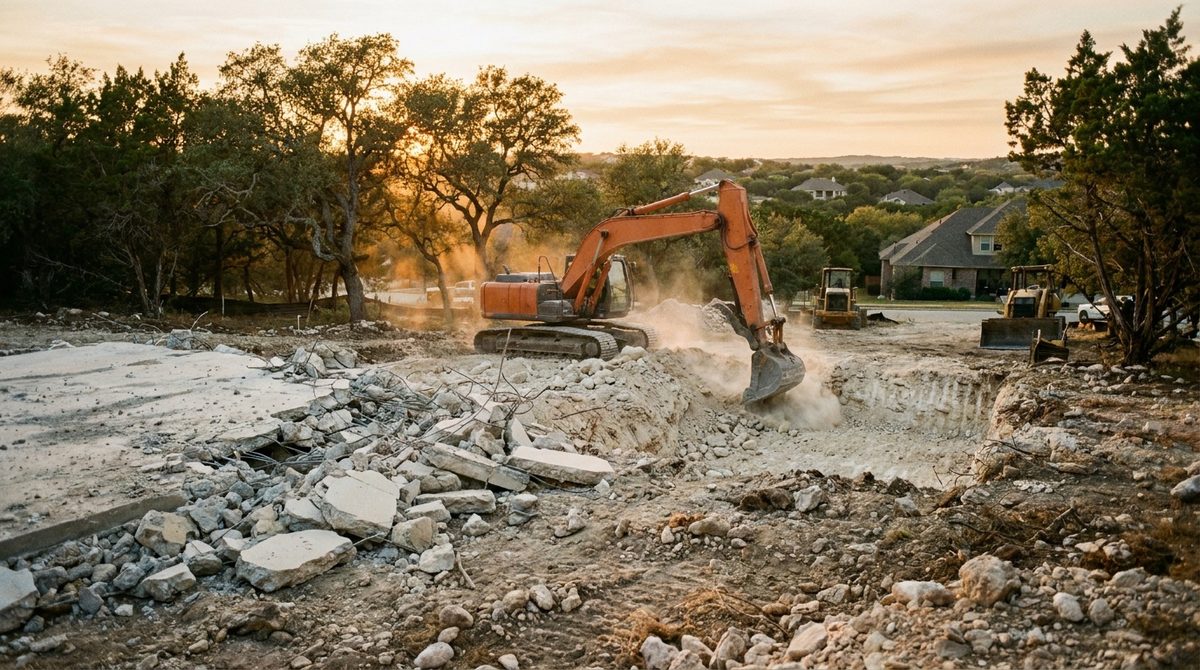
If you're planning any type of construction project, you've probably come across both terms. They're often mentioned together, sometimes handled by the same contractor — but they are not the same thing. Understanding the difference helps you scope your project correctly, hire the right people, and avoid critical gaps that cause delays before the real work even starts.
// In This Guide
// 01 + 02 The Core Difference
One simple way to think about it: demolition deals with what's above ground. Excavation deals with what's below it.
Removing What's There
Demolition is the controlled removal of existing structures, surfaces, and materials to prepare a site for what comes next. The goal is a clean, cleared site — everything that was built is gone.
- Tearing down homes, garages, and buildings
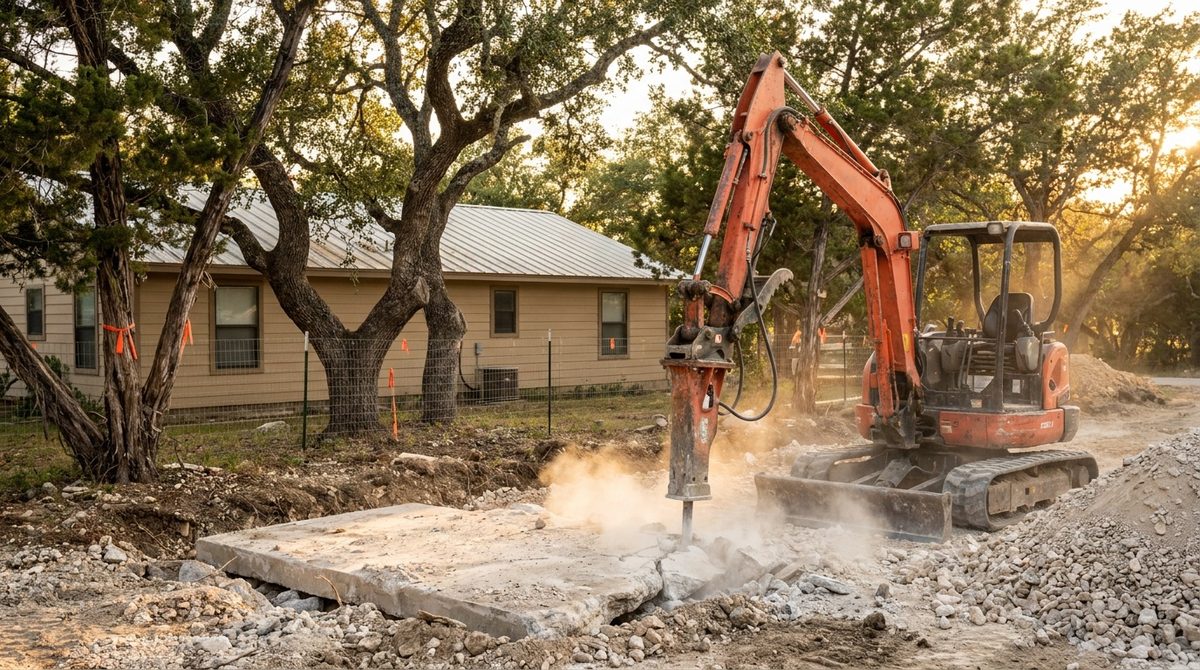
- Breaking up and removing concrete driveways, patios, and slabs
- Removing interior walls, flooring, or fixtures during renovation
- Clearing old foundations before a new one goes in
- Removing pool decks, fencing, and site structures
Shaping What's Next
Excavation is the removal of earth to prepare a site for construction. It's about the ground itself — shaping, removing, and preparing it for what will be built above.
- Digging foundations for homes or additions
- Pool shell excavation
- Site grading and cut/fill to design elevation
- Utility and drainage trenching
- Limestone rock breaking and on-site rock milling
// 03 Where They Overlap — Common Project Scenarios
Demolition and excavation frequently go hand in hand — which is exactly why they get confused. Here are the most common situations where both are required, and how they divide the work:
Teardown and Rebuild
Tearing down a home to build a new one requires both — in sequence. Demolition removes the existing structure and clears the lot. Excavation then prepares the ground for the new foundation. You can't start excavating until demo is complete, and demo without a plan for what gets excavated often creates problems.
Concrete Slab Removal
Breaking up and hauling away an existing concrete driveway, patio, or slab is demolition. If the project then requires digging below where the slab sat — for a new foundation, drainage system, or utility line — that becomes excavation. Same site, same general area, two distinct scopes.
Pool Installation
Removing an existing pool deck, fencing, or structures surrounding the pool area is demolition. Digging the pool shell itself is excavation — and in areas like Austin's Hill Country, that excavation may require hydraulic rock hammering through limestone. Both scopes need to be in the plan from day one.
Infill Development
Austin infill lots often start with an existing structure that needs to come down, then require full site prep: structure demolition, heritage tree protection, grading, and drainage verification — all before a foundation contractor ever sets foot on the lot. These projects are where the gap between demo and excavation scopes creates the most delays when they're not coordinated.
"The gap between demo completion and excavation start is where projects lose weeks. When the same crew handles both, that gap disappears."
— ClearGround, Austin TX · Salt Lake City UT
Not sure how your project breaks down? We'll walk through your scope, identify what's demo, what's excavation, and give you one quote that covers both.
Talk to ClearGround →// 04 Do You Need the Same Contractor for Both?
You don't have to use the same contractor for demolition and excavation — but the case for it is strong, especially on projects where the two scopes run sequentially or overlap.
Simpler. Faster. Fewer Gaps.
One point of contact, one timeline, and no coordination required between crews who don't know each other's plans.
- One mobilization cost instead of two
- Demo crew knows what the excavation requires
- No gap between demo end and excavation start
- Disputes about scope belong to one party
- One documentation package at project close
Coordination Becomes Your Job.
Delays on the demo side flow directly into excavation delays. What one crew leaves behind, the other crew has to work around.
- Two mobilization schedules to align
- Miscommunication about what stays and what goes
- Demo delays push excavation start date
- Disputes about scope damage between two parties
- You absorb the coordination overhead
If your project requires both, look for a contractor with documented experience in both — and ask specifically how they handle the handoff between the two scopes. That transition is where projects slip.
// Related See How This Applies to Your Project Type
Both demolition and excavation show up across different project types differently. These pages go deeper on the specific scopes.
Pool Excavation in Austin Limestone
How ClearGround handles the full scope — from deck demo to pool shell excavation through caliche and rock — for Hill Country pool builders.
See the pool builder page →Turnkey Site Prep, Demo Through Grade
For Austin infill developers navigating demolition, heritage tree compliance, and drainage verification — from one partner.
See the infill developer page →// Frequently Asked Questions
What is the difference between demolition and excavation?
Demolition is the removal of existing structures, surfaces, and built materials above ground level. Excavation is the removal of earth below ground level to prepare a site for construction. Demolition clears what's there. Excavation shapes what's next.
Do I need both demolition and excavation for my project?
Many projects require both. Teardown and rebuild projects need demolition first, then excavation for the new foundation. Pool installations often require demo of surrounding structures and excavation of the shell. Concrete removal is demolition; digging below where the slab was is excavation.
Should the same contractor do both demolition and excavation?
It's not required, but it helps. One contractor means one point of contact, one timeline, and no coordination gap between demo completion and excavation start. With two separate contractors, that gap becomes your responsibility — and any delays on the demo side flow directly into excavation delays.
How do I make sure both scopes are in my contractor's quote?
Ask explicitly: "Does this quote include both demolition and excavation?" Then ask for each scope to be itemized separately — what structures are coming down, what material is being removed, how deep the excavation goes, and how disposal is handled for both phases. Gaps between scopes show up in vague quotes.
// One Partner, Both Scopes
Demo to Final Grade.
Documented at Every Step.
ClearGround handles demolition and excavation across Austin and Salt Lake City — one mobilization, one timeline, RTK-verified documentation from start to handoff.
Get a Free Site AssessmentServing Austin, TX · Salt Lake City, UT