


MOBILE HOME DEMOLITION AND REMOVAL. THE PAD STAYS READY.
Single-wide and double-wide manufactured homes dismantled on site, hauled and recycled, piers and tie-downs pulled, utilities capped, and the pad graded for the next home or the next build. Part of our Austin demolition service — scanned before the first panel comes off, verified after the last load leaves.
Book a Site Scan
A MANUFACTURED HOME ISN'T A STICK-BUILT HOUSE.
IT COMES APART DIFFERENTLY.
Mobile home demolition is the dismantling and removal of a manufactured home — single-wide, double-wide, or the old trailer house behind the barn — down to the steel chassis, then the chassis, the piers, the tie-downs, and the skirting, then the utilities capped and the pad graded. A manufactured home is light: aluminum, wood, drywall, and insulation on a steel frame. Knocking it down is the easy part. The job is the sorting, the hauling, and everything that was hiding under the floor. ClearGround dismantles on site instead of dragging a rotten box down a county road, ticket-hauls every load, recycles the aluminum and steel, buries nothing, and hands back a pad that's been scan-verified to ±0.5 cm. Not just a wrecking crew. Not a junk hauler with a sledgehammer.
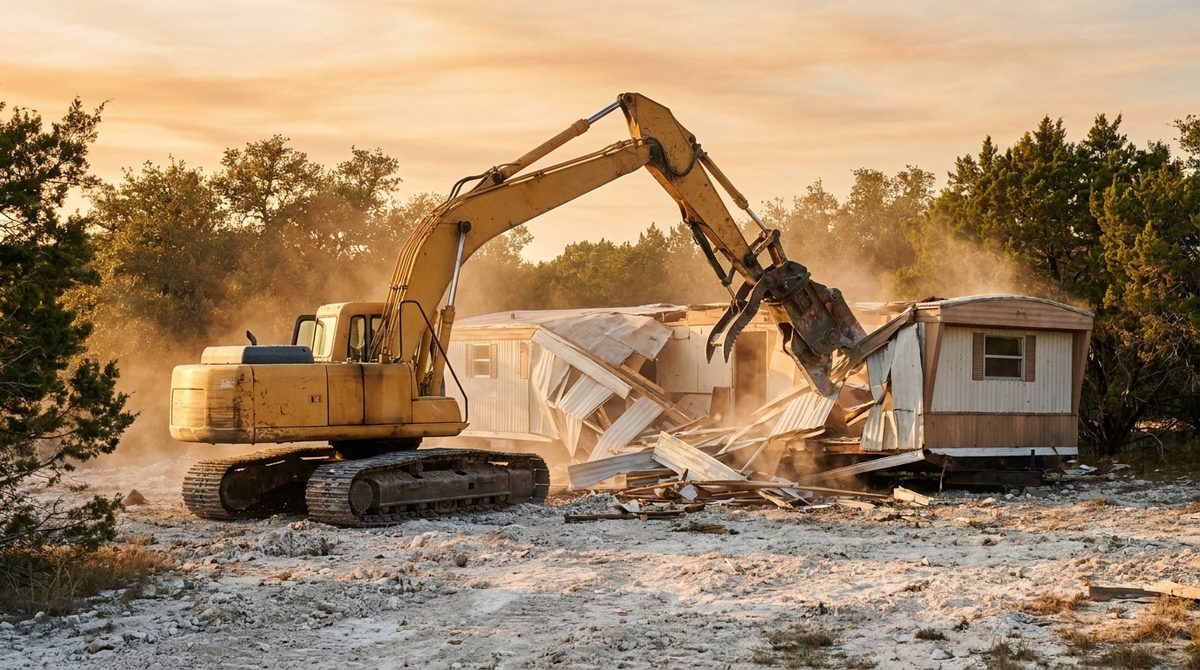
Mobile Home Demolition
One section, one steel chassis, roughly 12–18 ft wide and 40–80 ft long. The most common trailer house on rural lots and older parks. Roof and walls pulled apart from one side, chassis stripped and lifted whole, piers and anchors out behind it. Usually one to two roll-offs plus the steel.
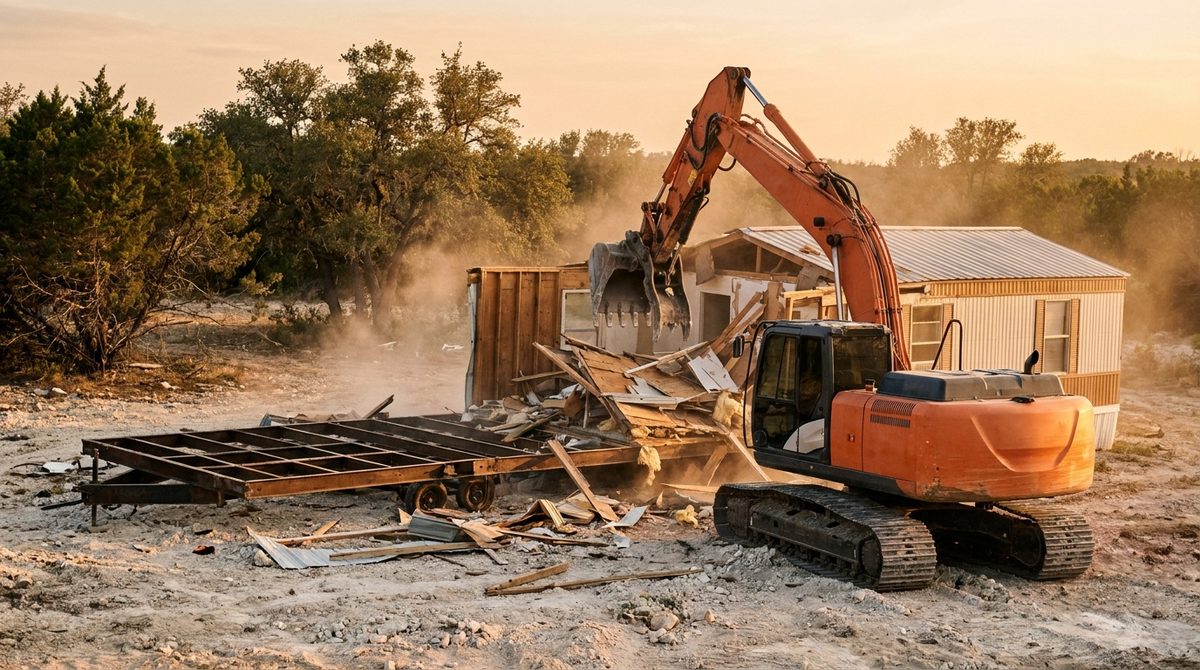
Manufactured Home Demolition
Two or three sections married on site, two or three chassis, twice the roof and drywall — and very often a site-built porch, carport, deck, or room addition that has to come down with it. More piers, more anchors, more loads. The pre-demo scan counts all of it before the price is set.
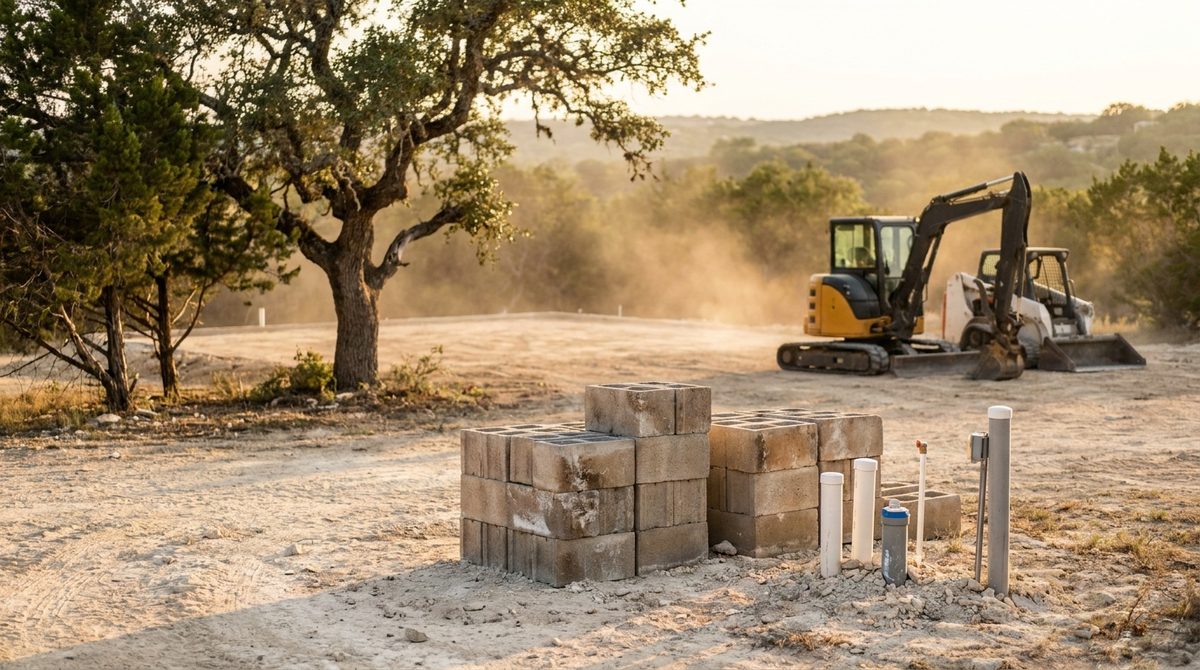
Park Pull-Outs
The inherited home nobody has lived in for years. The old trailer house on the back forty. A park owner retiring three units at once. Priced per home, mobilized once. Gate width, distance from the county road, and how far the roll-off truck can get to the home all show up in the price — before we sign, not after.
THE BOX IS THE EASY PART.WHAT'S UNDER IT IS THE JOB.
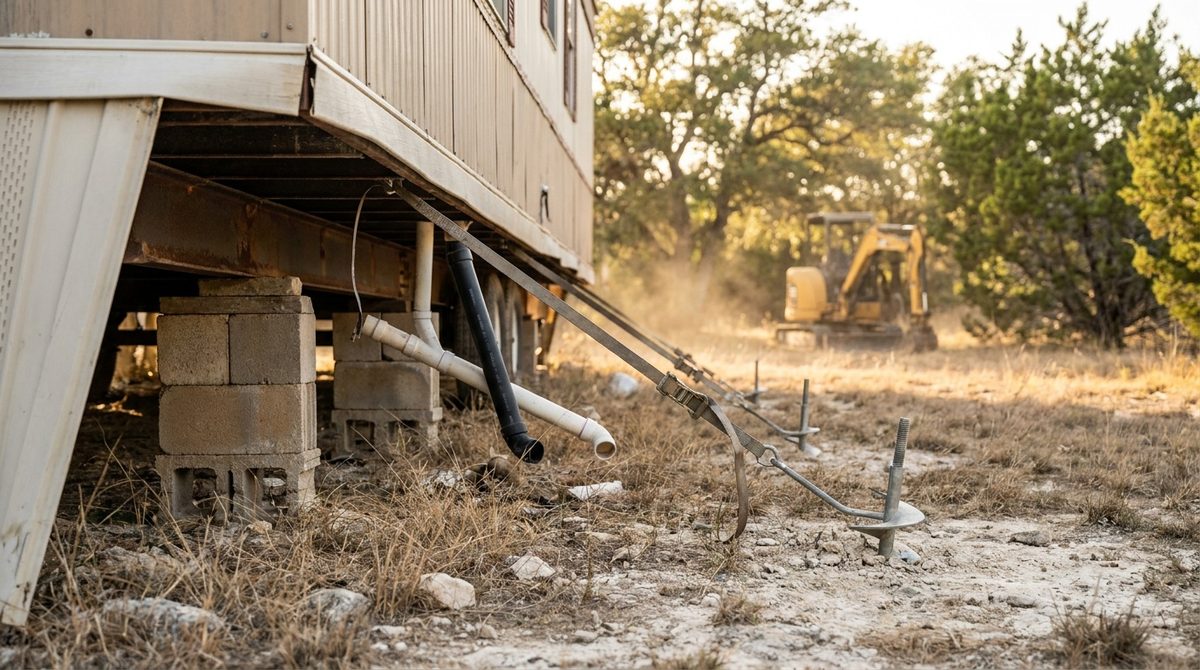
Pull the skirting off any manufactured home that's been sitting for twenty years and you'll find the part of mobile home removal that cheap quotes skip: block piers, steel straps and earth anchors, hanging drain lines, a sewer connection, sometimes a propane tank, sometimes a site-built porch slab. Every one of those either comes out with us or gets counted and priced before we mobilize. The RTK pre-demo scan and a walk-under inspection tell us what's there. Nothing gets cut off at grade and left for the next builder's footing to find.
THE TITLE PAPERWORK IS YOURS. THE DEMOLITION IS OURS.
A manufactured home in Texas carries its own ownership record with the state (TDHCA), separate from the land. Retiring or updating that record when the home is destroyed is the owner's responsibility — we don't file it for you and we won't guess at your situation. What we do give you is dated before-and-after scan evidence and a documented C&D packet showing the home is gone, which is the kind of proof owners usually need on hand. Two more things that sit on your side of the line before demo day: utilities disconnected at the meter by the utility or a licensed trade (we cap what's left at the stub), and any abatement a survey calls for on an older home finished first — we can point you to an abatement contractor. Permit requirements vary by jurisdiction; we tell you what applies to your lot and handle the demolition permit where we can.
ONE MOBILIZATION FROM
OLD TRAILER TO READY PAD.
Mobile home demolition is rarely the whole project. Something is going on that pad next — a new manufactured home, a stick-built house, a barn, or just clean pasture. ClearGround scopes the removal so the next step doesn't have to undo any of it: the pad is graded to the elevation the next home or builder needs, the old slabs are gone or kept on purpose, and the brush around the old home site can come out on the same trip. One crew, one documented handoff.
Owner's side: power, gas or propane, and water off at the meter; tank pulled by the supplier; title record handled; any abatement complete. We tell you what applies.
→This page. Dismantle, sort, haul, recycle. Piers, anchors, and skirting out. Utilities capped and flagged. Pad rough-graded and scan-verified.
→Grade and compact the pad for the next manufactured home, or cut a building pad for a stick-built house — site prep & pad prep. Old porch and carport concrete handled under concrete & slab removal.
→Cedar and brush around the old home site cleared under land clearing; any site-built footings under foundation removal. You get the 3D digital twin and the packet.
BEFORE THE FIRST PANEL COMES OFF.
The RTK drone scan maps the home, the additions, the drive, and the trees to ±0.5 cm. Then someone gets under the home: pier count, anchor type, where the sewer connection is, whether there's a slab under that porch, what's still inside the house. Access for the roll-off truck gets measured, not eyeballed. Everything we're going to dismantle, pull, haul, and grade is identified and priced before the excavator is loaded on the trailer. That's why the number doesn't move.
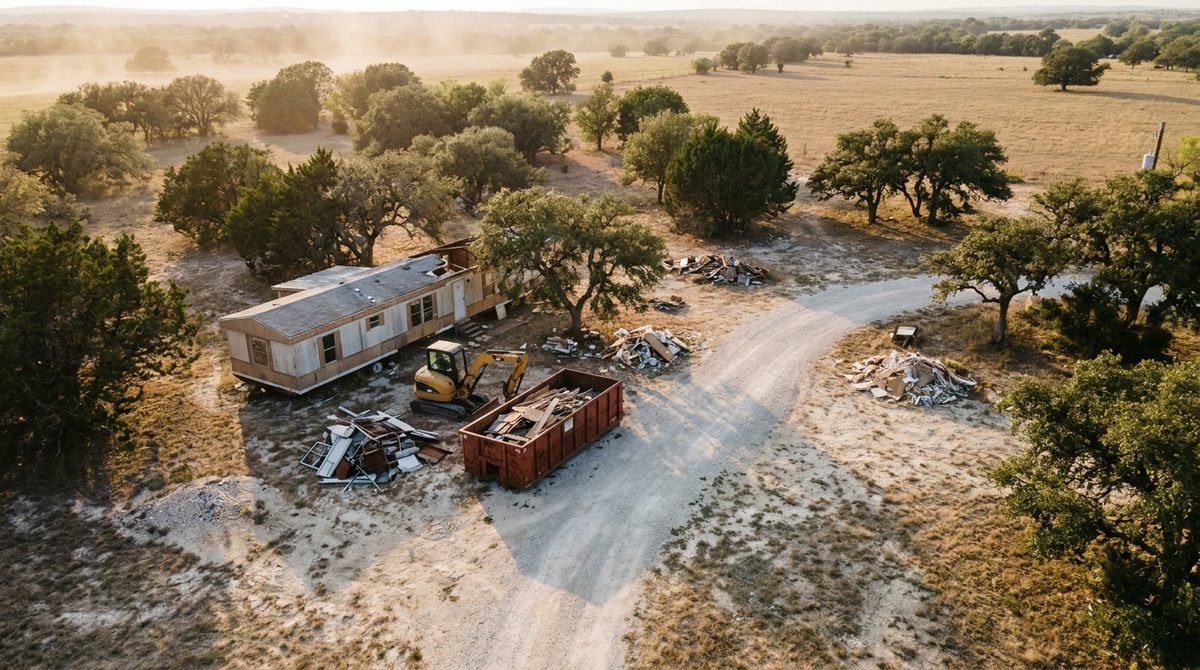
We don't haul manufactured homes away intact. A home old enough to demolish is rarely road-worthy, and moving one whole just relocates the problem. The CAT 308E2 CR with a hydraulic thumb opens the roof, folds the walls in, and pulls the floor off the frame one section at a time. Material is sorted as it comes down: aluminum siding and windows to one pile, wood, drywall, insulation, and shingles to the roll-off, and the steel chassis stripped bare and lifted whole onto a trailer for scrap. Dust is kept down, and neighbors on a park lot see a tidy site, not a bonfire.
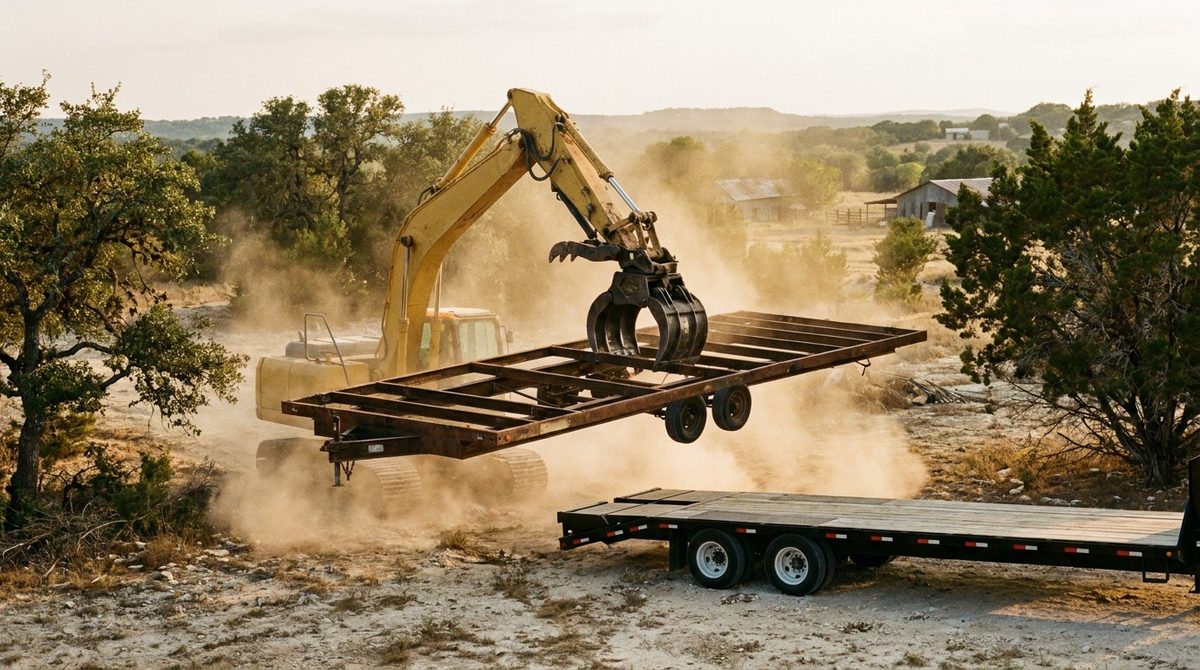
With the frame gone, the footprint is open. Block piers are pulled and stacked. Earth anchors are backed out of the ground, straps and all. Skirting, hanging drain lines, and the sewer connection are removed. Water, sewer, and electric are capped at the stub and flagged so the next home can tie back in or the builder knows where to find them. If a site-built porch slab or carport footing is in scope, the NPK GH6 hydraulic hammer breaks it and it leaves with the concrete. Nothing is cut off at grade and buried. Nothing is left in the grass.
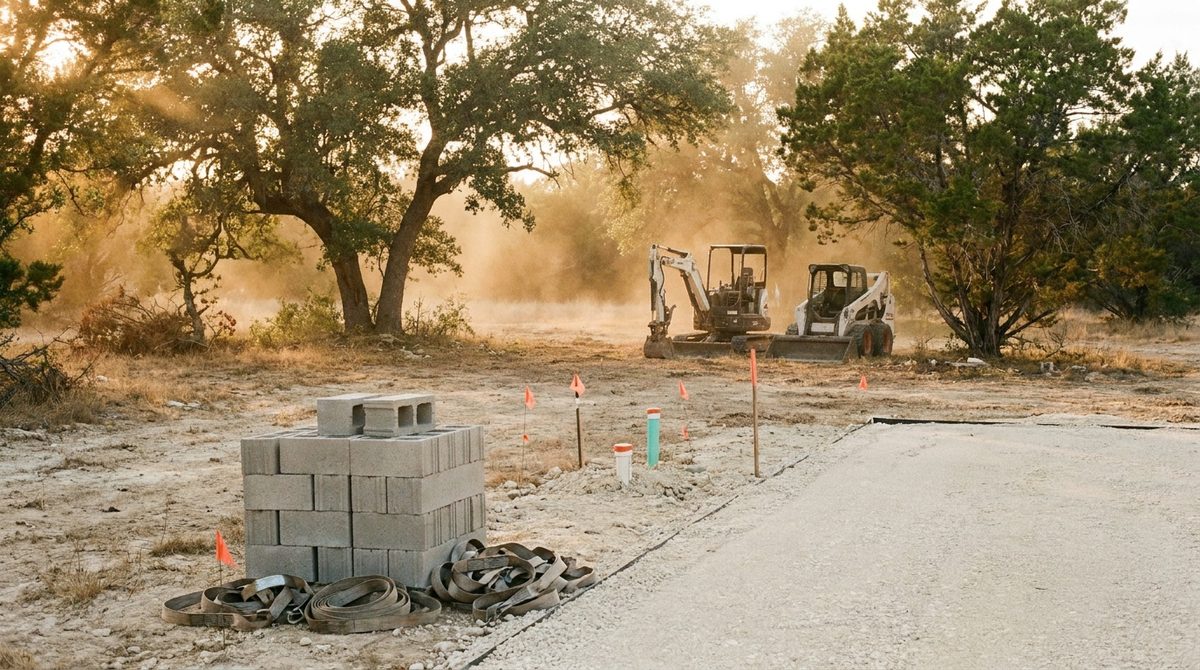
Pier holes and anchor voids are backfilled and compacted. The pad is rough-graded to drain — to the elevation the next manufactured home needs, or as the starting surface for a building pad if a house is going there instead. Then the drone flies the post-demo verification scan. Pre-scan against post-scan gives you volumes removed and the finished elevation across the whole footprint, measured, not described. If we said the pad would be ready for the next home, the scan is how we prove it.
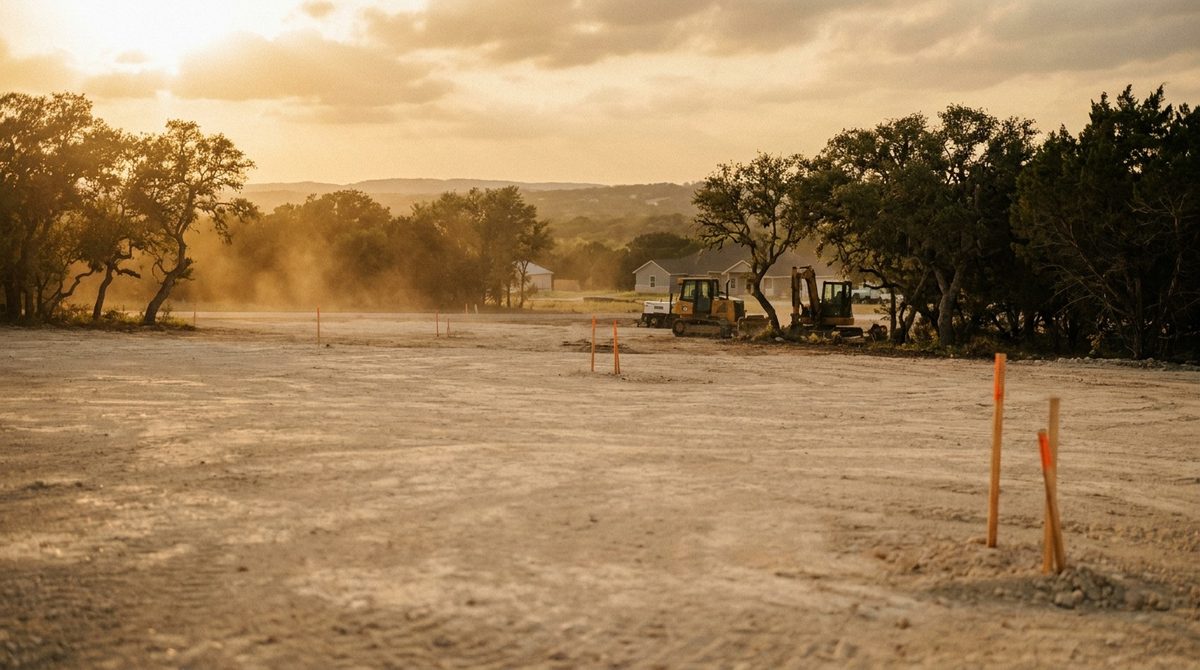
Every load left on a ticket. The aluminum, steel, concrete, and C&D recycling are documented. You get the before-and-after scans, the volume report, and a 3D digital twin of the finished pad. For an estate, that packet is what the executor keeps. For a park owner, it's what the file needs. For a landowner setting a new home, it's what the dealer's set-up crew reads before they show up. For anyone who has to show the state the home was destroyed, it's dated evidence in hand.
MOBILE HOME DEMOLITION COST.
PRICED PER HOME. FIXED AFTER THE SCAN.
Most mobile home demolition and removal in Central Texas lands between $5,000 and $12,000 per home. A single-wide with clean access sits toward the low end. A double-wide with a site-built porch, a long dirt drive, and a house still full of furniture sits toward the high end. The pre-demo scan and under-home inspection turn that range into one number, and the number is fixed before the excavator moves.
All pricing reflects typical Central Texas residential and light-commercial work. Single-wides fall toward the low end of the $5,000–$12,000 range; double-wides, site-built additions, long haul distances, and homes still full of contents push toward the high end. Your exact price is fixed after the RTK site scan and does not move unless the scope does. Title retirement, utility disconnects, and any abatement are outside this scope and are handled before we mobilize.
NOT THE CHEAPEST QUOTE YOU'LL GET. ON PURPOSE.
A junk hauler with a trailer and a sledgehammer can beat this number, and on a mobile home removal they often will. What that quote usually leaves behind: block piers in the grass, anchors cut off at grade, a sewer line open under six inches of dirt, a burn pile, and nothing on paper. Then you pay someone else to finish it, or the next builder finds it with a footing, or the park's file has a hole in it. We dismantle and recycle instead of burying. We pull instead of cutting. Every load leaves on a ticket, and the scan proves the pad. That's what the price is for.
Compact radius excavator with hydraulic thumb. The thumb is what makes manufactured home demolition clean: it peels roof and wall sections off instead of smashing them, lifts the stripped chassis whole onto a trailer, and pulls block piers and earth anchors out of the ground. Fits down a ranch drive and through a park lot without tearing up the neighbors' pads.
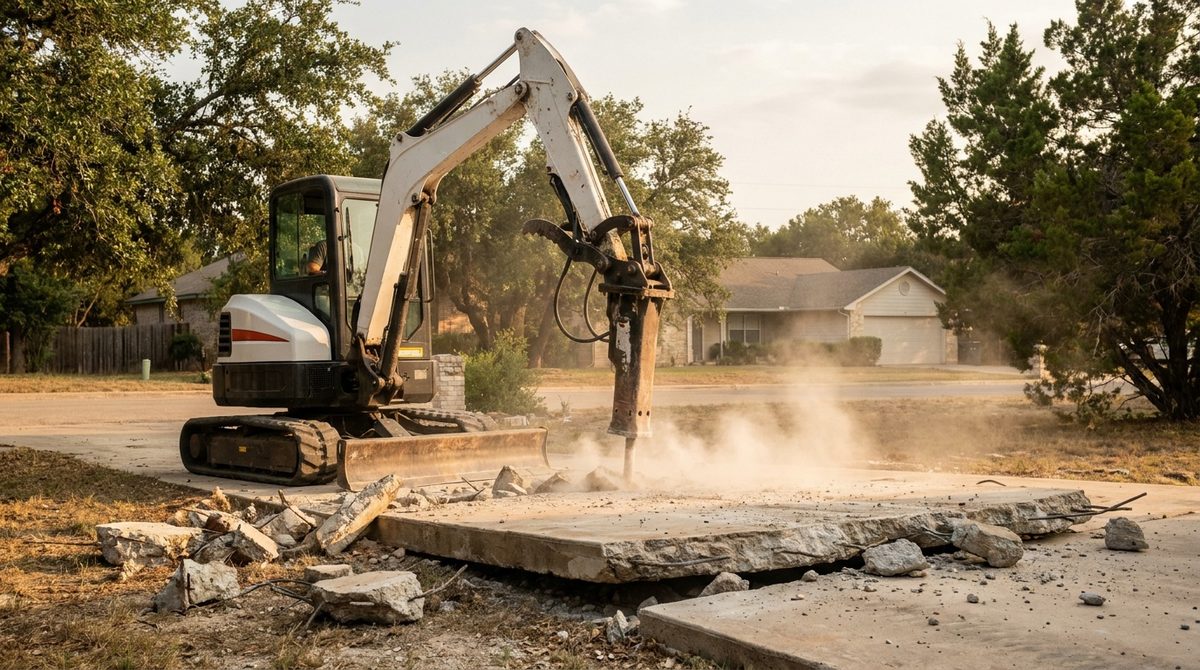
1,500 lb hammer class on the same carrier. Only comes out when there's concrete to break: a site-built porch slab, a carport pad, poured pier footings, or an old patio next to the home. The pre-demo scan tells us whether the hammer is needed at all, so you're not paying for a tool that stays on the trailer.

Survey-grade RTK drone, ±0.5 cm horizontal accuracy. Flies the pre-demo scan that counts the additions, the access, and the footprint, and the post-demo verification that proves the pad elevation and the volume removed. Produces the 3D digital twin that goes in your packet.
ALUMINUM ONE WAY. STEEL ANOTHER.
NOTHING BURIED ON SITE.
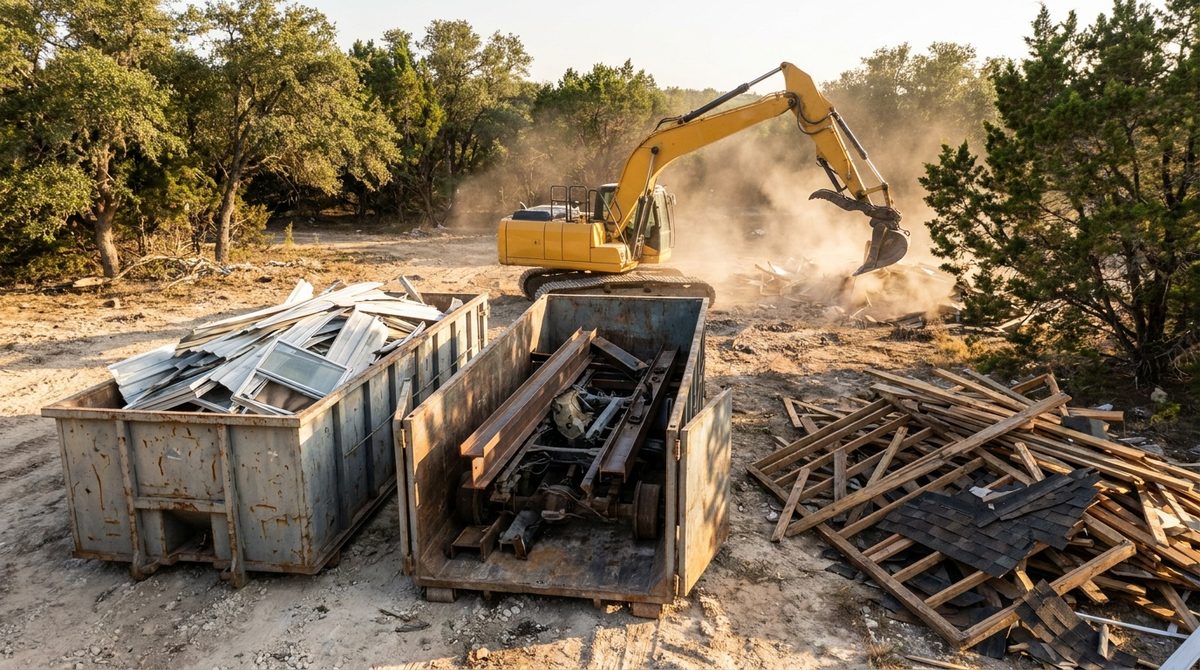
A manufactured home is one of the most recyclable structures we take down, if somebody bothers to sort it. Aluminum siding, window frames, and trim are nonferrous scrap. The chassis, axles, straps, and anchors are steel. What's left — wood, drywall, insulation, shingles, and carpet — is ordinary C&D. ClearGround sorts as the home comes down, so the aluminum never gets buried in a mixed roll-off and the steel leaves as a clean load. Every ticket comes back in your packet.
The Old Trailer House
Has to Go Before Anything Else Can Happen.
You inherited the place, or you bought the acreage with the home already on it, and it's been sitting since before you had keys. Selling, building, or setting a new home all start with getting it off the pad properly — not dragged into the tree line. ClearGround gets down a dirt road, takes the home apart on site, pulls what's under it, and leaves a scan-verified pad and a packet the executor, the buyer, or the dealer's set-up crew can read.
Talk to Us About Your PropertyRetire the Unit.
Keep the Pad and the Neighbors.
Abandoned and end-of-life units cost a park in rent, liability, and appearance. Pulling them out means working between occupied homes with tight lanes, shared utilities, and people watching. We scope multiple units on one mobilization, keep the site tidy while the neighbors are home, cap and flag every utility stub so the next tenant's set-up is straightforward, and document each unit separately for the park's file.
See All Demolition ServicesTypical mobile home demolition and removal runs $5,000–$12,000 per home. That covers dismantling on site, hauling, recycling, pulling the piers and tie-downs, capping the utilities, and grading the pad. The three things that move the number most: the size of the home (single-wide versus double-wide), what's attached to it (site-built porches, carports, decks, additions), and how hard it is to get a roll-off truck to it. What's still inside the home matters too — a house full of furniture is extra loads. The pre-demo scan turns the range into a fixed price. You can rough out a starting number on the demolition calculator or read the demolition cost guide.
A single-wide typically lands toward the low end of the range — roughly $5,000–$8,000 — and a double-wide toward the high end, roughly $8,000–$12,000. A double-wide isn't just twice as long; it's two chassis to strip and load, twice the roof and drywall, more piers and anchors under the floor, and it almost always came with a site-built porch or addition that has to come down with it. Triple-wides and homes with large additions can run past the top of the range, and we'll tell you that before we quote, not after.
We dismantle on site and recycle. Hauling a manufactured home intact needs a home that's still road-worthy — sound frame, axles, tires, hitch — and a transport permit, and a home that's reached the point of demolition almost never qualifies. Moving it whole also just relocates the problem to someone else's lot. Taking it apart where it sits lets us sort the aluminum, the steel, and the C&D as it comes down, which is what gets it recycled instead of landfilled. If your home is genuinely in good shape and you're looking to relocate or sell it rather than demolish it, that's a different service and we'll say so.
Usually: concrete block piers or poured pads under the chassis, steel tie-down straps running to screw-in earth anchors, vinyl or metal skirting, hanging drain lines, the water supply, the sewer connection, and electric to a pedestal or panel. Sometimes: a propane tank, a site-built porch slab, a carport pad, a deck on its own footings. The piers, anchors, skirting, and plumbing come out as part of every job; the utilities are capped and flagged at the stub. Propane tanks go back to the supplier before demo day. Slabs and footings are broken and hauled when they're scoped. Septic tanks are located and protected but are separate scope. The pre-demo scan and a walk-under inspection are how we know what's there before we price it.
The ownership record for a manufactured home in Texas is kept by the state (TDHCA), separately from the land, and updating or retiring that record when the home is destroyed is the owner's responsibility. We don't file it, and we're not going to give you legal or title advice we're not qualified to give. What we can do is make sure you have what an owner usually needs in hand: dated before-and-after scans, load tickets, and recycling documentation that show the home was demolished and removed on a specific date. If you're an executor or you bought the land with a home already on it, sort out who's on the record before demo day — it's easier with the home still standing.
Disconnects happen before we mobilize, on your side of the line: power off and the meter pulled by the utility or co-op, propane tank emptied and picked up by the supplier, water shut at the meter or well. We'll tell you exactly what needs to happen and in what order. On demo day we remove the lines under the home, cap the water, sewer, and electric at the stub, and flag them so the next home can tie back in or the builder knows where they are. Septic tanks and lids are located on the scan and protected during the work; abandoning or replacing a septic system is separate scope we can point you to.
Yes, and that's usually the plan. Pad graded is part of every mobile home demolition: pier holes and anchor voids backfilled and compacted, the footprint rough-graded to drain, utilities capped and flagged where the new home will tie in. If the new home's set-up crew or the dealer has a spec — pad elevation, gravel, a poured runner, a bigger footprint — that's site prep and pad prep, and we scope it on the same mobilization so you're not paying two crews to touch the same dirt. The post-demo RTK scan gives you and the set-up crew the finished elevation to ±0.5 cm before they schedule.
Permit requirements vary by jurisdiction — inside a city, in the ETJ, or in unincorporated county land, and by whether the home is on its own parcel or in a park. We tell you what applies to your lot and handle the demolition permit where we can. On the schedule: a single-wide is typically one to two days on site, a double-wide two to three. Add a day for a large porch or a lot of contents to haul. We quote within 48 hours of the scan and mobilize within 48 hours of acceptance. Older homes may need an asbestos survey and, if it finds anything, abatement before we mobilize; we don't do abatement, and we can point you to a contractor who does.
Every demolition service we run, the equipment behind it, and the RTK verification that comes with all of them.
View Service →Stick-built residential teardowns for rebuilds, inheritors, and infill developers. Slab, timeline, and what's left when we're done.
View Service →Outbuildings on the same lot as the mobile home — the shed, the carport, the old barn — often scoped on the same mobilization.
View Service →Porch slabs, carport pads, and old patios next to the home. $4–8/sf, rebar separated, concrete recycled.
View Service →Site-built additions and old pier-and-beam footings left on the property. Extracted, backfilled, subgrade verified.
View Service →Pad built to the new home's spec, or a building pad for a stick-built house. Same crew, same mobilization.
View Service →Cedar, brush, and overgrowth around the old home site cleared while the equipment is already on the property.
View Service →Inground pool removal — shell broken, steel separated, backfill compacted and verified.
View Service →Limestone shelves and embedded rock under the next pad, broken in place with the hydraulic hammer.
View Service →Single-story retail, shop, office, and warehouse structures with weekly verified volume reports.
View Service →How a demolition job actually runs in Central Texas, from permits and disconnects to the final scan.
Read Guide →What drives the price on every structure type we remove, and where the ranges come from.
Read Guide →MOBILE HOME TO REMOVE?
WE SCAN IT FIRST.
RTK site scan and under-home inspection confirm the size, the additions, the piers, and the access before we quote. Fixed price within 48 hours, 48-hour mobilization, and a pad that's verified before the next home shows up.
Book a Site Scan48-hour mobilization · Austin, Hill Country & Central Texas · Fixed-price proposals · Licensed & insured, $5M general liability · 512-880-8888