


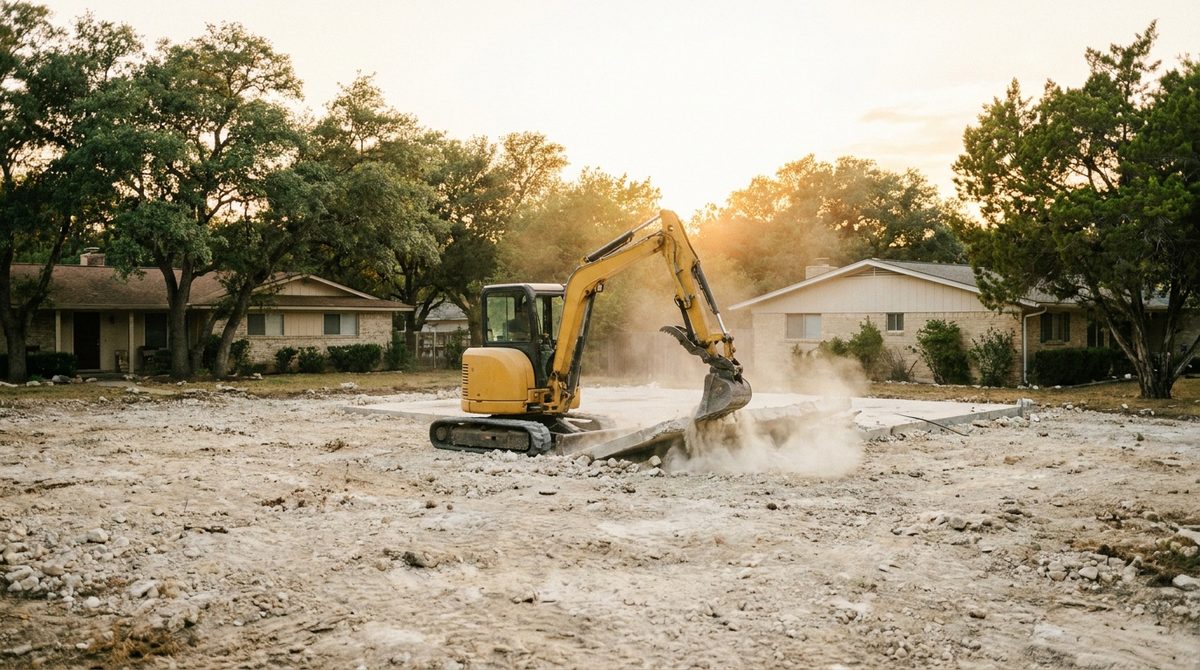
Demolition is the first phase of most teardown-and-rebuild projects. In Austin it comes with a permit, a Historic Preservation check for older houses, utility disconnects and a neighbor notice. This guide walks through each step and what it costs.
In this guide
What is residential demolition?
Residential demolition is the controlled removal of structures, surfaces and materials to prepare a site for what comes next. Common jobs include house teardowns, garage and outbuilding removal, concrete driveway and patio removal, old foundation removal before a new build, and pool removal.
What are the steps to get an Austin demolition permit?
These are the City of Austin's steps for a residential total demolition, in the order the City lists them. Source: City of Austin Demolition Permit page and Austin Development Services, checked September 28, 2026. Historic review detail: Austin Historic Preservation. Commercial notification: Texas DSHS.
| Step | What happens | Who |
|---|---|---|
| 1. Confirm new construction will be permitted | The City asks you to verify that new construction will be permitted at the site before you apply. | Owner or contractor |
| 2. Submit the application | Demolition Permit Application and Affidavit of Compliance, through the Residential Total Demolition Permit web form. | Owner or contractor |
| 3. Historic Preservation review | Residential structures 45 years or older are reviewed by the Historic Preservation Office in Austin Planning, and possibly the Historic Landmark Commission. The application is routed internally; you take no extra step. The City does not publish a review time. | City |
| 4. Asbestos notice | A single private residence, or an apartment building with no more than four dwelling units, is excluded from Austin's asbestos compliance notification. Commercial demolitions need the Asbestos Compliance Notification Form. Texas DSHS separately requires notification at least 10 working days before demolition of public and commercial buildings. | Operator files for commercial jobs |
| 5. Tree permit, if it applies | Needed if the work will remove a protected-size tree, impact its critical root zone, or prune more than 25% of its canopy. | Owner or contractor |
| 6. Permit activation | A Pre-Demolition Inspection Fee is required for total demolitions. | Owner or contractor |
| 7. Utility release | Request disconnect and removal of Austin Energy and Austin Water services through the City's Utility Contact Center at 512-494-9400. Gas and other services go through their own providers. | Owner or contractor |
| 8. Environmental and trade inspections | Upload the Refrigerant Disposal Acknowledgment, then schedule the Pre-Construction Environmental Inspection, Tree Inspection and Building Pre-Construction Inspection. The inspector verifies utilities are handled and approves the Demolition Notification Packet. | Contractor |
| 9. Neighbor notification | Five to 10 business days before demolition activity, post door hangers and yard signs and upload the Demolition Notification Acknowledgment. The minimum five-day window starts the day the acknowledgment is uploaded. | Contractor |
| 10. Demolition | Work starts once the notification window closes and the required inspections pass. | Contractor |
| 11. Final inspections | Schedule and pass the final environmental and building inspections to close the permit. | Contractor |
Timeline: the City does not publish a permit review time, so we cannot give you a number. The one fixed wait is the neighbor notification window, five days minimum. Ask the City or your contractor where your application stands. Not legal advice; rules change, so confirm on the City page before you file.
What does the demolition process look like?
Every job moves through four phases. Here is what each one involves and where mistakes happen.
Site assessment
Your contractor visits the property. The visit sorts out what comes down, what stays, which utilities need disconnecting and which permits apply.
A contractor who quotes without seeing the site is guessing or leaving room to change the price later.
Permits and utility disconnection
The permit steps are in the table above. Gas, electric, water and sewer all have to be disconnected before the structure comes down.
If something goes wrong on an unpermitted demolition, your insurance may not cover it.
Demolition
The structure and material come out. A house teardown looks different from concrete slab removal, and the machine has to fit your lot.
Debris removal and site clearing
Debris is hauled and the site is cleared for excavation, foundation work or new construction.
What types of demolition are there?
Full structure demolition
The whole structure comes down to grade. It takes heavy equipment, a permit, full utility disconnection and a debris plan.
Concrete demolition
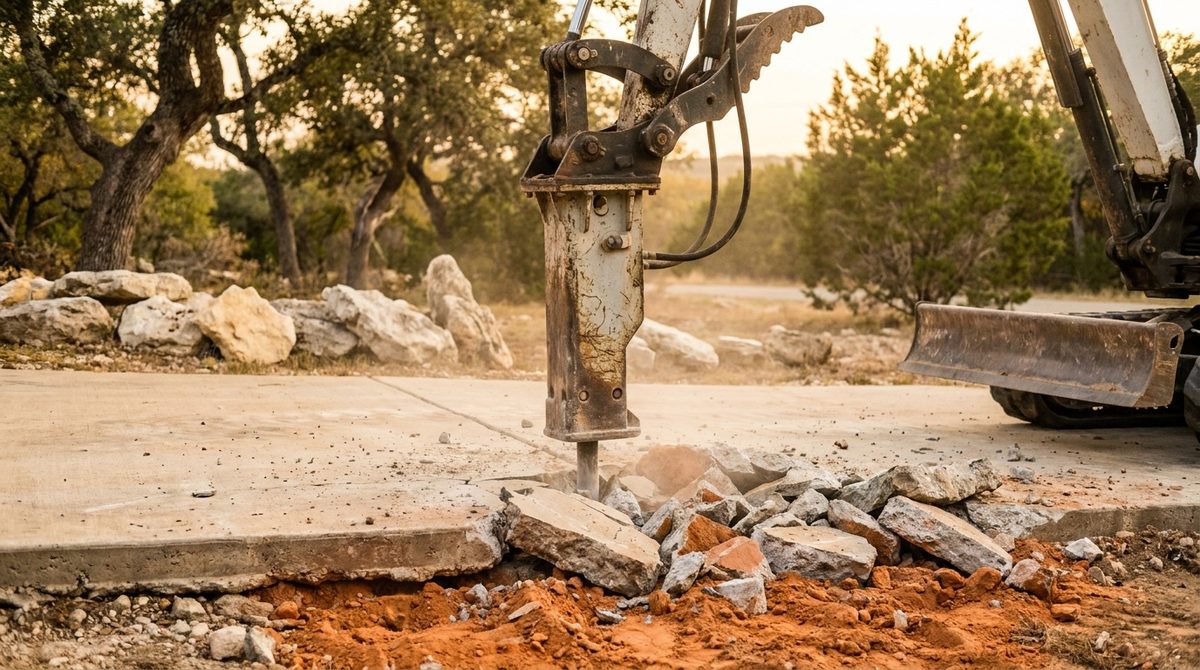
Driveways, patios and slabs are broken with hydraulic equipment and hauled. Rebar adds time.
Foundation removal
Old slabs, footings, piers and buried masonry are broken out and hauled, then the void is backfilled and compacted. A drone models the ground surface. Rock, footings and buried lines below the surface are found with test holes, probing, 811 locates and GPR where needed.
Pool demolition
The whole shell and the coping come out (the deck too, if you want it gone), and the hole is filled in compacted lifts (lab testing is an add-on). Full removal keeps the lot buildable. The paperwork matters when you sell.
What affects demolition cost?
A house runs $9,000–$25,000 per house. A slab runs $4–$8 per sq ft. Pool removal runs $15,000–$88,000 per pool, from a sunken garden to full removal. The demolition cost guide has the full table and a worked example.
Prices reviewed: September 2026. Ranges for Austin and Central Texas; your site walk sets the final number.
See pricing. Full rate ranges are on our pricing page. To size your own job, use the demolition calculator.
Not sure what your demolition will cost? We walk every site before quoting.
Get a site assessmentWhat should you look for when hiring a demolition contractor?
Experience with your project type
House teardowns, concrete removal and pool removal take different equipment and skills. Ask for photos or references from a similar job nearby.
A detailed scope of work
The quote should say what comes down, how debris is handled, which permits are needed and who pulls them, and what the site looks like at the end. A vague quote changes after work starts.
Proof of insurance
Texas does not license general or site-work contractors at the state level, so proof of insurance carries the weight. Ask for a certificate showing general liability and workers' compensation before work starts.
Before you sign: demolition quote checklist
- What is coming down: structure, concrete, foundation, or all three
- How debris is handled and whether haul-off is in the price
- Which permits are required and who pulls them
- Who coordinates utility disconnects and who confirms they are done
- What condition the site is left in (cleared to grade, ready for excavation)
- Whether an asbestos or lead assessment applies to your structure
- Certificate of insurance showing general liability and workers' compensation
Common questions
What is residential demolition?
Residential demolition is the controlled removal of a house, outbuilding, slab, foundation or pool to prepare a site for what comes next. It covers full teardowns, concrete removal, old foundation removal and pool removal.
How much does residential demolition cost?
A house runs $9,000–$25,000 per house, slab removal runs $4–$8 per sq ft, and pool removal runs $15,000–$88,000 per pool, from a sunken garden to full removal. Hazardous materials, access and haul-off move the number, so we price after a site walk.
Do I need a permit to demolish a house in Austin?
Yes. The City of Austin requires a demolition permit application and an Affidavit of Compliance through its Residential Total Demolition Permit web form. Structures 45 years or older also get a Historic Preservation review.
Does a house demolition in Austin need an asbestos notice?
Austin's asbestos compliance notification excludes a single private residence or an apartment building with no more than four dwelling units. Commercial demolitions need the notice.
How long before demolition can start?
The City does not publish a permit review time. After the permit is active, contractors must post neighbor notices and wait a minimum of five days from the day the acknowledgment is uploaded. Most jobs start 1–3 weeks after approval.
What is the difference between full demolition and concrete demolition?
Full demolition takes a structure down to grade. Concrete demolition removes slabs, driveways, patios and foundations, often as the last step after a teardown or as a standalone job.
What happens after demolition is complete?
Debris is hauled, the site is cleared, and the lot moves on to excavation, foundation work or new construction with a documented handoff.
Ready to start?
Scoped. Permitted.
Handed off clean.
Every project is assessed on site, permitted, and handed to the next contractor with the lot cleared and documented.
Get a free site assessmentAustin, the Texas Hill Country and Central Texas