


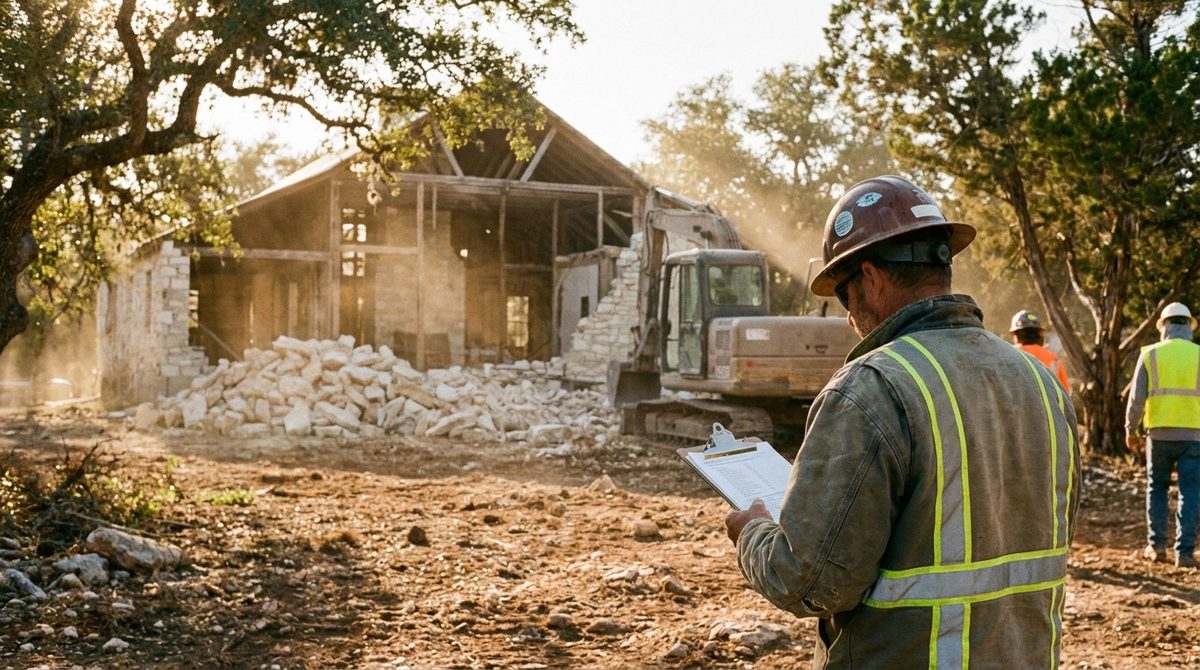
Demolition prices vary more than most homeowners expect — and the gap between bids on the same project is almost always explained by factors the low quote didn't include. Understanding what actually drives demolition cost is how you budget accurately, evaluate competing quotes, and avoid being caught off guard once work has started.
// In This Guide
// 01 Why Demolition Can't Be Priced Without Seeing the Site
Demolition doesn't have a flat rate. The cost depends on scope, materials, site access, and disposal — and all of those factors vary property to property. There are too many variables to assess accurately over the phone.
⚠ What This Means for You
A contractor who gives you a firm price over the phone without a site visit is either guessing or leaving enough margin to cover the unknowns — unknowns they'll convert into change orders once they're already on your property. A detailed site assessment before quoting is the only way to give you a number that holds.
// 02 What Actually Drives Demolition Cost
These five variables account for nearly all the price variance you'll see between bids on the same project. Understanding each one helps you evaluate whether a quote is complete — or missing something.
Size and Scope
Tearing down an entire home is a fundamentally different job than removing a concrete patio. The larger and more complex the structure, the more equipment hours, crew time, and debris volume are involved — all of which compound cost. Scope is almost always the single biggest line item in a demolition quote.
Materials Involved
Older structures can contain hazardous materials — lead paint, asbestos — that require specialized handling and disposal before demolition can begin. This adds both time and cost that a standard quote won't anticipate. Always ask your contractor whether a hazmat assessment is needed before work starts. Finding out mid-demo is expensive.
Debris Disposal and Haul-Off
Everything removed from your property has to go somewhere. Some contractors include haul-off in the quoted price; others price it separately. A full home teardown generates vastly more debris than a slab removal — and that difference shows up in disposal cost. This is one of the most common items missing from low bids.
Permit Requirements
Permit costs vary by city and county. In Austin and Salt Lake City, requirements differ depending on the type and scale of the work. A contractor with local experience knows exactly what your project will require — and can factor real permit costs into the quote before you commit to a timeline.
Site Conditions and Access
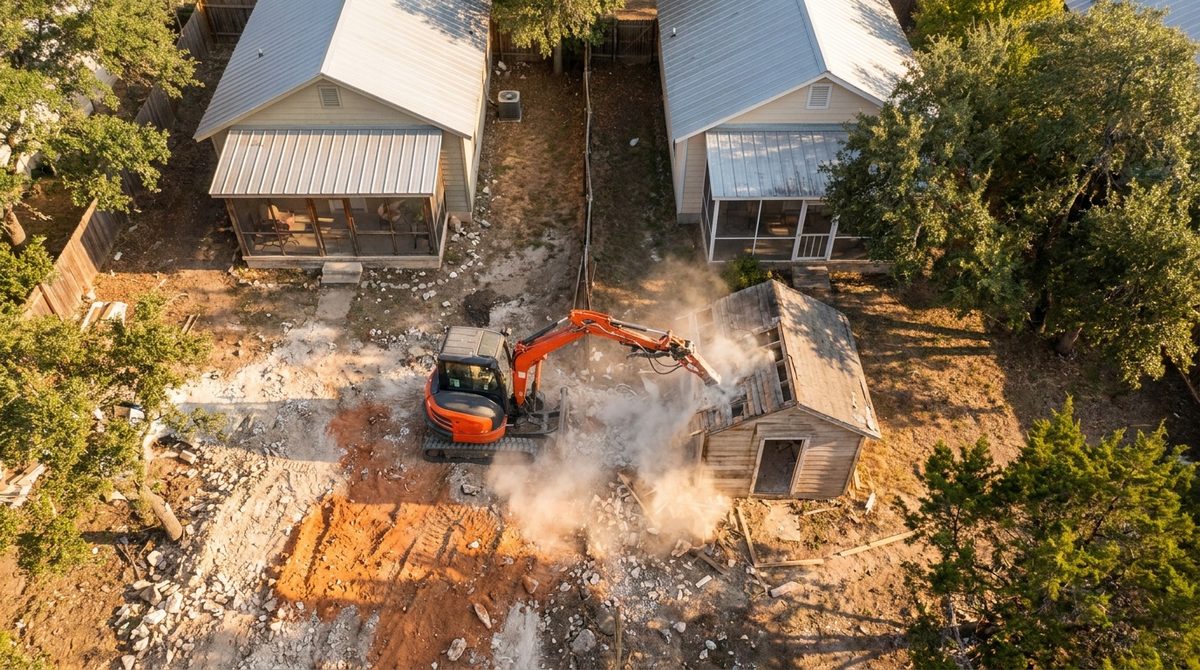
Tight lots, narrow access routes, and structures close to neighboring properties all require more careful, slower work. In Austin's infill neighborhoods — where 50×100 lots with neighbors 5–10 feet away are common — the wrong equipment can't even access the site. Access constraints add time, and time is cost.
"The most expensive surprise in demolition is a change order that didn't have to exist. A detailed site assessment eliminates most of them before work starts."
— ClearGround, Austin TX · Salt Lake City UT
// 03 Cost by Project Type
Every project is different, but these patterns hold across most residential demolition scopes. Use them as a starting framework — not a substitute for a site-specific quote.
Want a real number for your project? We assess every site before quoting — no phone estimates, no change order surprises.
Get a Site Assessment →// Interactive Tool
Demolition Cost Estimator
Get a rough ballpark for your project type. This is a starting point — not a quote. Site conditions, materials, and access constraints can shift any number significantly.
// Estimated Range
// Estimates are illustrative ranges based on typical market conditions in Austin TX and Salt Lake City UT. Actual cost depends on site-specific conditions including structure condition, hazardous materials, access constraints, and permit fees. This tool is not a quote. A site visit is required for accurate pricing.
// 04 Red Flags in Demolition Quotes
These patterns don't always mean a contractor is dishonest — but they do mean the quote isn't complete. Each one is a reason to ask more questions before you commit.
A Quote That Seems Unusually Low
Low bids almost always mean something isn't priced in. Disposal, permits, hazmat handling, or access complexity are commonly omitted. The problem is you usually find out after the contractor is already on your lot — at which point your options are limited. If a bid is significantly below the others, ask specifically what it doesn't include.
No Mention of Debris Disposal or Haul-Off
Haul-off is one of the most commonly omitted line items in demolition quotes. If the quote doesn't specify how debris will be handled and whether disposal is included in the price, that's a gap — and it will cost you. Ask for written clarification before signing.
No Site Visit Before the Quote
Any contractor who gives you a firm number over the phone without seeing the property is either guessing or padding the quote to cover unknowns. A site visit isn't a formality — it's the only way to price accurately. If a contractor won't visit before quoting, that should give you pause.
No Mention of Permits or Utility Disconnection
A quote that doesn't address permits or utility disconnection is incomplete by definition. Most demolition requires both. A contractor who skips these steps — or doesn't mention them — is either unaware of the requirements or hoping you won't ask.
// Frequently Asked Questions
How much does it cost to demolish a house?
Full home demolition is priced by square footage, with additional costs for hazardous materials, basement removal, and foundation demolition. Structure condition, site access, and disposal requirements all affect the final number significantly. A site visit is required for accurate pricing — averages without one are guesses.
How much does concrete removal cost?
Concrete removal is typically priced by square footage or slab thickness. Reinforced concrete with rebar takes significantly more time to break up and remove, which increases cost. Disposal of the broken concrete is often priced separately — always confirm what's included.
Why do demolition quotes vary so much?
Quotes vary because contractors account for scope, materials, access, disposal, and permits differently. A low quote usually means one or more of those variables isn't priced in — they show up as change orders once work begins. A detailed, itemized quote that addresses all five is more likely to hold.
Is debris removal included in demolition quotes?
Not always. Some contractors include haul-off; others price it separately. This is one of the most common sources of post-signing surprises on demolition projects. Always confirm what's included before you sign, and get the answer in writing.
// Ready for a Real Number?
Every Quote Starts
With a Site Visit.
ClearGround quotes are itemized, site-specific, and cover scope, disposal, permits, and handoff to the next phase. No surprises on billing day.
Get a Free Site AssessmentServing Austin, TX · Salt Lake City, UT