


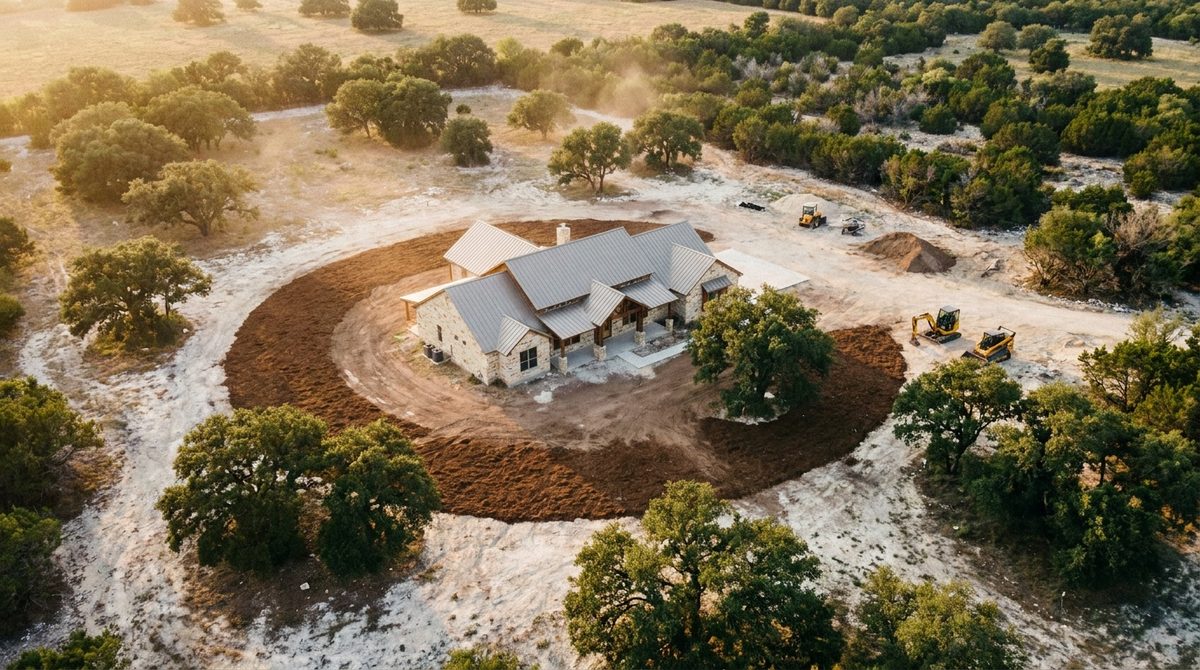
Wildfires don't give advance warning. For homeowners in fire-prone regions like Texas Hill Country and Utah's Wasatch Front, the time to prepare is before fire season — not during it. The goal of wildfire prevention isn't to remove every tree on your property. It's to strategically clear the vegetation that allows fire to travel toward your home, and to document that it was done.
// In This Guide
// 01 What Defensible Space Actually Is
Defensible space is a cleared buffer zone around your home that removes the fuel fire needs to reach your structure. The goal isn't to strip your property bare — it's to eliminate the vegetation that allows fire to travel quickly toward your home while preserving trees and native species that don't pose direct fire risk.
Most wildfire guidelines — including NFPA and Firewise standards — break defensible space into zones based on distance from the structure.
The vegetation immediately surrounding your structure — Zone 1, within roughly 30 feet — carries the highest risk. Embers from a fire 100 feet away can land on or against your home in seconds if there's no cleared buffer. The further out the zones extend, the more the goal shifts from protection to slowing the fire's approach.
// 02 Why It Works — and Why It's Required in Some States
The majority of homes lost in wildfires are lost because fire traveled through surrounding vegetation and reached the structure. Vegetation is fuel. A cleared buffer zone interrupts that fuel chain.
Studies consistently show that homes with properly established defensible space have significantly higher survival rates during wildfires. Defensible space is one of the few wildfire risk factors that is entirely within a property owner's control.
For properties in high-risk areas, having defensible space is no longer just recommended. States and municipalities — Utah leading among them — have begun mandating it with verified compliance requirements. Property owners who don't comply face financial penalties. Property owners who clear but can't prove it face the same problem.
"Most clearing companies will mulch your cedar and leave. They'll call it wildfire prevention — but they can't prove what was removed, they don't measure your defensible space zones, and they don't give your insurer anything to work with."
— ClearGround, Austin TX · Salt Lake City UT
// 03 How Professional Wildfire Prevention Clearing Works
Effective defensible space clearing involves more than cutting brush. Here's what a properly scoped wildfire prevention service covers:
Fire Risk Assessment and Pre-Scan
Before a single branch is cut, a professional contractor assesses your property's fire fuel load — vegetation density, canopy coverage, dead material accumulation, and proximity to structures. A thorough assessment identifies which zones need what level of clearing and which trees and species should be preserved.
Fuel Load Removal
Cedar, juniper, mesquite, dry brush, and dead vegetation are the primary carriers that allow fire to travel. In Texas Hill Country, Ashe juniper (cedar) is the most volatile — dense, highly flammable, and aggressively spreading. In Utah's WUI zones, oak scrub and Gambel oak are the primary ladder fuels. Removing and managing these from the perimeter of your property is the starting point of any defensible space plan.
Zone Clearing Per Firewise/NFPA Guidelines
Professional wildfire prevention contractors clear to specific zone specifications based on your property's layout, slope, and proximity to the structure. Zone 1 — directly adjacent to the home — requires the most intensive treatment. Zones 2 and 3 focus on reducing fuel density and removing ladder fuels that allow ground fire to climb into tree canopy. Clearing that doesn't follow zone specifications doesn't meet insurance or administrative standards.
Documentation
Completing the clearing is only half the job. In Utah, it has to be proven. Under HB 48, defensible space compliance must be verified and documented to qualify for fee reductions and insurance carrier acceptance. Without proper records, the clearing may as well not have happened from a compliance standpoint.
Want to know what your property's fire risk looks like? ClearGround's RTK pre-scan maps your vegetation density, structure proximity, and zone requirements before we give you a number.
Book a Free Site Scan →// 04 The Difference Between Cleared and Compliant
This is the gap most homeowners don't realize exists until it's too late. A property can be cleared and still not be compliant — because compliance requires proof.
- Shows up, cuts brush, leaves
- No pre-clearing fire risk assessment
- No zone measurement or verification
- No Firewise or NFPA standard applied
- Before/after photos at best
- Nothing usable by your insurer or fire marshal
- Cannot support HB 48 compliance in Utah
- RTK drone maps fire fuel load before clearing
- Selective clearing preserves desirable species
- Zone 1/2/3 measured and verified to Firewise spec
- Clearing follows NFPA best practices
- 3D digital twin documents every foot of clearance
- Shareable proof for insurers, fire marshals, HOAs
- HB 48 documentation-ready in Utah
// Why Documentation Matters
When your insurer asks whether you've established defensible space, photos aren't documentation. A geo-referenced 3D model with timestamped before/after comparison and zone measurements — delivered on a shareable platform — is what "documented" actually means.
ClearGround delivers this as a standard project deliverable on every fire mitigation project. Not an add-on. Not an upgrade. The proof is part of what you're paying for.
// 05 Texas Hill Country vs. Utah Wasatch Front
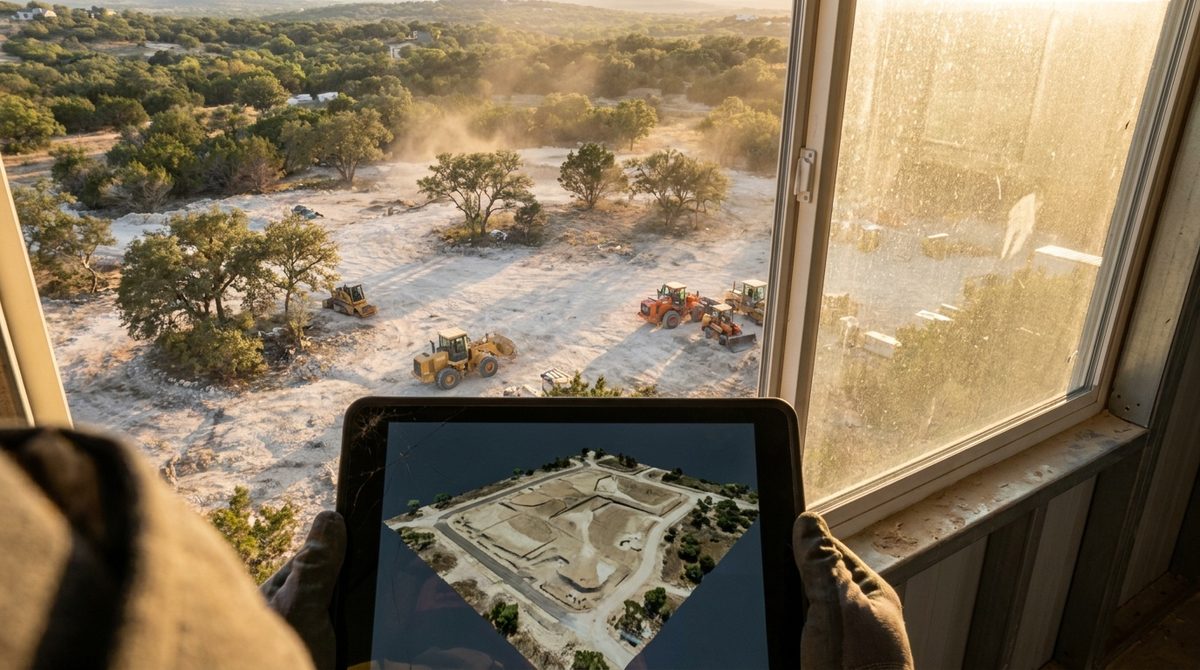
Both markets carry significant wildfire risk — but the specific threats, vegetation, and compliance requirements differ. Here's what's relevant for each.
Ashe Juniper Is the Primary Threat
Ashe juniper (cedar) is the Hill Country's primary fire accelerant — highly volatile, aggressively spreading, and often the dominant vegetation on estate and ranchette properties. Dense cedar thickets carry fire faster than almost any other native Texas vegetation.
Firewise is the primary compliance framework in Texas. While state-mandated defensible space requirements are less prescriptive than Utah's HB 48, insurance carriers increasingly require documented mitigation for properties in the Hill Country WUI.
HB 48 Makes Documentation a Legal Requirement
Utah's HB 48 requires property owners in designated WUI zones to establish and document defensible space. Salt Lake City and the broader Wasatch Front are among the highest-risk zones in the state. Non-compliance carries financial penalties.
Documentation under HB 48 isn't optional. Property owners who clear their defensible space but can't prove it with verified records face the same compliance exposure as those who didn't clear at all. The RTK documentation ClearGround delivers is specifically designed to satisfy this requirement.
// 06 When to Schedule Wildfire Prevention Services
// Timing Recommendations by Market
Texas Hill Country: Get ahead of the dry summer months. Late fall through early spring is the ideal window — vegetation is dormant, fire risk is temporarily lower, and contractors have more scheduling availability before the season rush.
Utah Wasatch Front: With HB 48 in effect, getting documentation on record before the annual assessment period is a priority for any property owner inside the WUI boundary. Don't wait until fire season to start the process — permit timelines and contractor availability both tighten significantly as spring approaches.
Defensible space clearing is not meant to be a one-time project. Vegetation grows back and fuel loads rebuild over time. Annual maintenance clearing keeps your buffer zones effective and your documentation current — both of which matter when your insurer reviews your coverage.
// Go Deeper ClearGround's Fire Mitigation Service Pages
The service pages go deeper on equipment, phase-by-phase process, and market-specific compliance details.
Wildfire Prevention — Hill Country
Cedar fuel reduction, Firewise compliance, and RTK documentation for Austin TX and Hill Country properties.
See the Texas fire mitigation page →Wildfire Prevention — Wasatch Front
HB 48 compliant defensible space clearing with RTK-verified documentation for Salt Lake City and WUI properties.
See the Utah fire mitigation page →// Frequently Asked Questions
What is defensible space?
Defensible space is a cleared buffer zone around your home that removes the fuel fire needs to travel toward your structure. It is divided into zones by distance — Zone 1 (0–30 ft) is cleared most aggressively, with lower intensity treatment in Zones 2 and 3. Professional contractors clear to NFPA and Firewise standards.
Does defensible space actually work?
Yes. Studies consistently show that homes with properly established defensible space have significantly higher survival rates during wildfires. Defensible space is one of the few wildfire risk factors entirely within a property owner's control.
Is defensible space required by law in Utah?
Yes. Utah HB 48 requires property owners in designated WUI zones to establish and document defensible space. Salt Lake City and the Wasatch Front are among the highest-risk zones covered. Non-compliance can result in financial penalties, and documentation of the clearing is required — not just the clearing itself.
When is the best time to schedule wildfire prevention clearing?
Before fire season begins. In Texas, that means late fall through early spring. In Utah, property owners inside WUI boundaries should get documentation on record before the annual HB 48 assessment period — don't wait until spring. Annual maintenance is recommended to keep fuel loads managed and documentation current.
What does wildfire prevention documentation actually need to include?
For insurance and compliance purposes, documentation should include a geo-referenced before/after comparison showing cleared acreage, zone measurements (Zone 1/2/3 from structure), and confirmation that clearing met Firewise or NFPA standards. A timestamped, shareable 3D model satisfies these requirements. Photos do not.
// Ready to Protect Your Property?
Don't Just Clear the Brush.
Prove It's Gone.
ClearGround clears to Firewise and NFPA standards and delivers RTK-verified documentation on every fire mitigation project — the proof your insurer and state require.
Book a Free Site ScanServing Austin, TX · Texas Hill Country · Salt Lake City, UT