


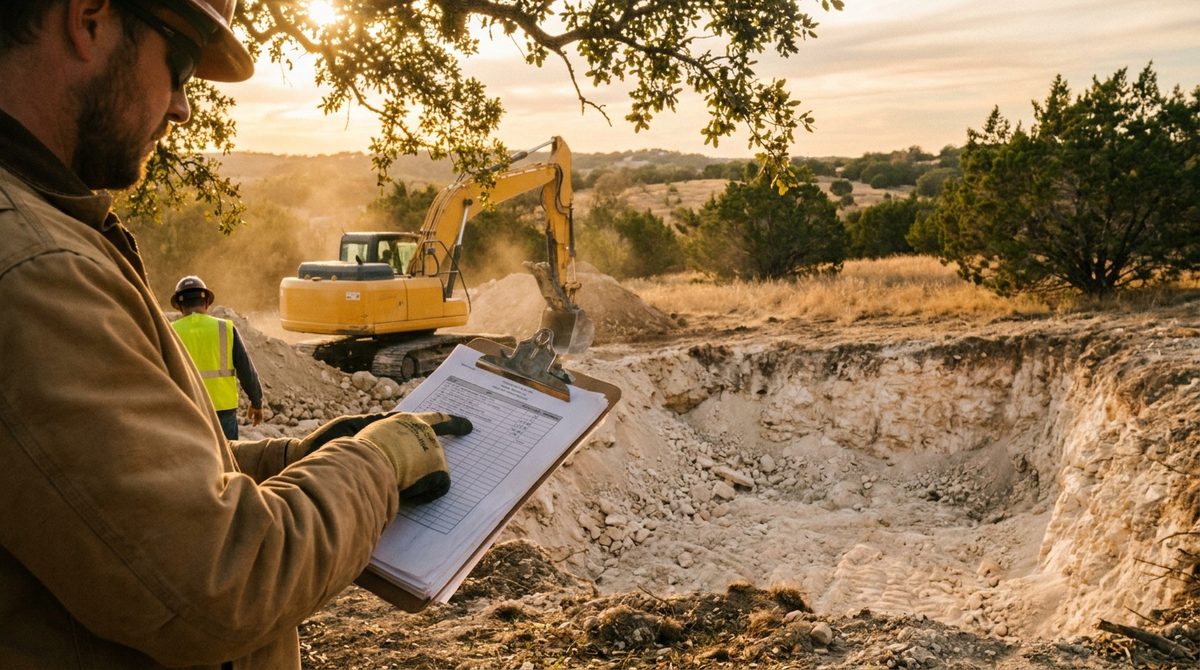
Excavation cost is one of the most searched — and least understood — topics in residential construction. Two homeowners with seemingly identical projects can receive quotes thousands of dollars apart, and both numbers can be completely legitimate. Understanding what actually drives the cost is how you budget accurately, evaluate competing bids, and avoid being caught off guard once digging begins.
// In This Guide
// 01 Why Excavation Can't Be Priced Without Seeing the Site
Unlike most home services, excavation doesn't have a flat rate or a reliable per-square-foot average. The only way to price a project accurately is to assess the specific lot — what's in the ground, how deep the dig needs to go, and how equipment will access the site.
⚠ What This Means for You
A contractor who gives you a firm price over the phone without visiting the property is either guessing or building in enough margin to cover the unknowns — unknowns they'll price into change orders once they're already on your lot. A detailed site assessment before quoting isn't extra caution. It's the only way to quote accurately.
// 02 The Main Factors That Drive Excavation Cost
These five variables account for almost all of the price variance you'll see between bids on the same project. Understanding each one will help you evaluate whether a quote is thorough — or leaving something out.
Ground Conditions
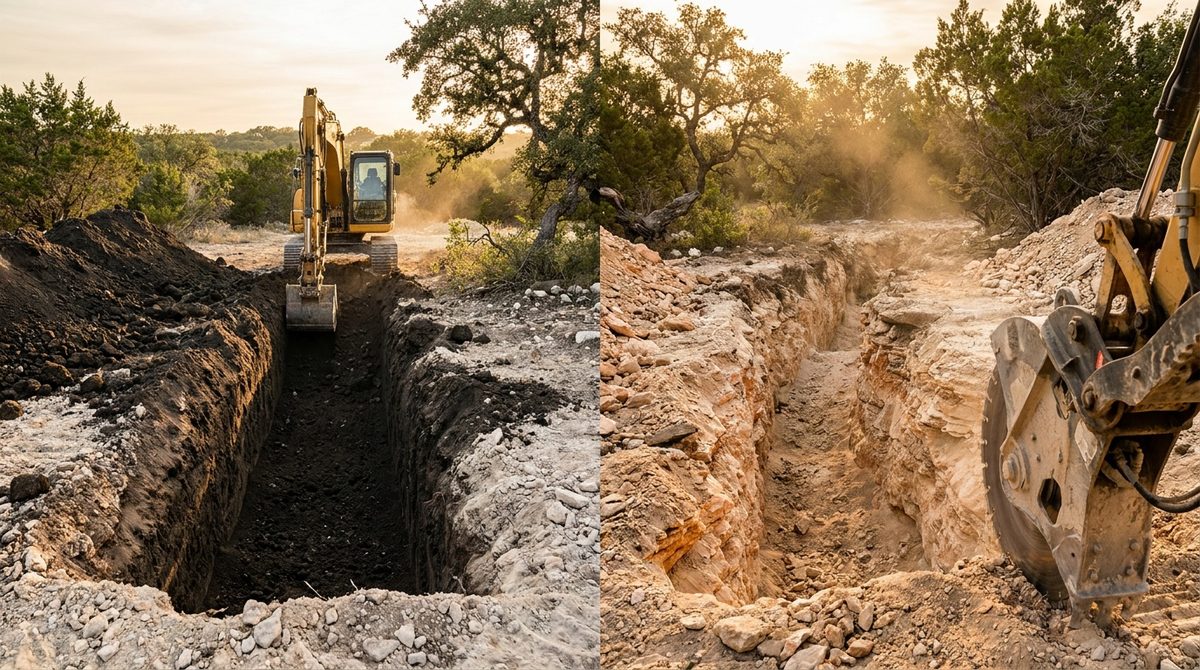
This is the single biggest variable. Hard rock — limestone, caliche, dense clay — requires specialized equipment and significantly more time per cubic yard than soft soil. In Austin's Hill Country and Salt Lake City's Wasatch Front, encountering rock isn't the exception. It's the norm. Contractors who don't ask about subsurface conditions aren't pricing the job — they're guessing.
Volume of Material
Excavation is typically priced per cubic yard. A deeper foundation, a larger pool shell, or a bigger grading scope means more material moved regardless of ground conditions. Depth and width both compound quickly — a small change in dimensions can meaningfully shift the total cubic yards and therefore the final cost.
Hourly Rates vs. Cubic Yard Pricing
Some contractors price by the hour; others by the cubic yard. Neither method is inherently better — they suit different project types. Hourly rates give contractors flexibility on unpredictable scopes. Cubic yard pricing gives you more cost certainty on well-defined, larger projects. The important thing is to understand which model your quote is using, and to get an estimated total either way.
Disposal and Haul-Off
Excavated material has to go somewhere. When contractors can repurpose material on-site for grading or fill, haul-off costs are eliminated or reduced. When material has to leave the property — especially rock — disposal adds meaningfully to the total. This line item is frequently omitted from vague quotes, and it's one of the most common sources of post-signing surprises.
Lot Access
Open sites allow larger, faster equipment. Tight residential lots require compact machines that move more slowly and take longer to complete the same volume of work. Narrow gates, steep slopes, and overhead obstacles all limit equipment options and add time — and time is cost. If your lot has access constraints, they need to be in the quote.
// 03 Average Cost Ranges by Project Type
Every project is unique, and ground conditions can shift any of these ranges significantly. Use these as a starting point for budgeting — not as a substitute for a site-specific quote.
"The contractors who give the most accurate quotes are the ones who ask the most questions before they give you a number. That's not hesitation — that's precision."
— ClearGround, Austin TX · Salt Lake City UT
// Hourly vs. Cubic Yard Which Pricing Model Is Right for Your Project?
Hourly Rate
The contractor charges per hour of equipment and crew time. Your total depends on how long the job actually takes — which can vary based on what they find underground.
Cubic Yard Pricing
The contractor quotes a rate per cubic yard of material moved. Your total is tied to the volume of work — giving you more predictability on larger, well-scoped projects.
Whichever model your contractor uses, always ask for an estimated total — even if the final number depends on conditions. "I can't give you any estimate" is a red flag. A range based on best and worst case scenarios is reasonable. No estimate at all is not.
Not sure what model your project fits? We'll assess your site, tell you which pricing approach makes sense, and give you a detailed quote with no line items hidden.
Get a Site Assessment →// Interactive Tool
Excavation Cost Estimator
Get a rough ballpark for your project type. This is a starting point — not a quote. Ground conditions alone can shift any number significantly.
// Estimated Range
// Estimates are illustrative ranges based on typical market conditions in Austin TX and Salt Lake City UT. Actual cost depends on site-specific conditions. This tool is not a quote. A site visit is required for accurate pricing.
// 04 What a Good Quote Should Always Include
A thorough excavation quote is a contract in draft form. If something isn't specified in writing, you have no protection when it becomes a dispute. Here's the minimum a legitimate quote should cover:
Quote Review Checklist
- Excavation depth and final dimensions clearly stated
- How ground conditions and rock will be handled — and how they affect pricing if conditions change
- Disposal method specified: is haul-off included, or is it extra?
- Grading scope defined if applicable
- Timeline, mobilization costs, and any standby fees
- Pricing model stated clearly: hourly or per cubic yard
- Change order process explained: what triggers one and how it's priced
A rule of thumb: a vague quote is a quote that will change. If any item above is missing, ask for written clarification before you sign anything.
// 05 Red Flags in Excavation Pricing
These patterns don't always mean a contractor is dishonest — but they do mean the quote isn't complete. Each one is a reason to ask more questions before committing.
A Quote That Seems Unusually Low
Low quotes almost always mean something isn't accounted for. Ground conditions, disposal, or access complexity are commonly left out. The problem is you usually don't find out until the contractor is already on your lot — at which point you have limited options. If a quote is significantly below the others, ask specifically what it doesn't include.
No Questions About Ground Conditions
Any contractor in Austin or Salt Lake City who doesn't ask about soil type and rock depth before quoting is not pricing the job accurately. These markets regularly encounter limestone and caliche that fundamentally changes the scope. A contractor who skips this question is either inexperienced with local conditions or building in enough margin to cover what they haven't asked about.
Hourly Rates With No Estimated Total
Hourly pricing is legitimate for certain projects. But hourly pricing with no estimated range — even a wide one — gives you no way to budget and no basis for comparison. Any contractor who can't offer a rough estimate based on project type and their local experience isn't giving you enough information to make a decision.
// Frequently Asked Questions
How much does foundation excavation cost?
Foundation excavation cost depends on square footage, required depth, and ground conditions. Soft soil excavation runs significantly less than hard rock conditions. In areas like Austin, TX with limestone caliche, rock hammering can substantially increase cost and timeline. A site assessment is required for accurate pricing — averages without a site visit are guesses.
Why are excavation quotes so different from contractor to contractor?
Quotes vary because contractors account for risk and unknown ground conditions differently. A low quote often means unknowns aren't priced in — they show up as change orders once work begins. A detailed quote that explicitly addresses ground conditions, disposal, and access is more likely to hold.
Is excavation priced per hour or per cubic yard?
Both models are used. Hourly pricing suits smaller or unpredictable projects. Cubic yard pricing gives more cost certainty on larger, well-defined scopes. Always ask which model your contractor uses and request an estimated total — even on hourly projects.
What should an excavation quote always include?
At minimum: excavation depth and dimensions, how ground conditions and rock will be handled and priced, whether disposal and haul-off are included, grading scope if applicable, and timeline and mobilization costs. A vague quote is a quote that will change.
// Ready for a Real Number?
Every Yard Billed
Is a Yard Proven.
ClearGround quotes are line-itemized, site-specific, and backed by RTK drone documentation before and after every project. No guesswork. No change order surprises.
Get a Free Site AssessmentServing Austin, TX · Salt Lake City, UT