


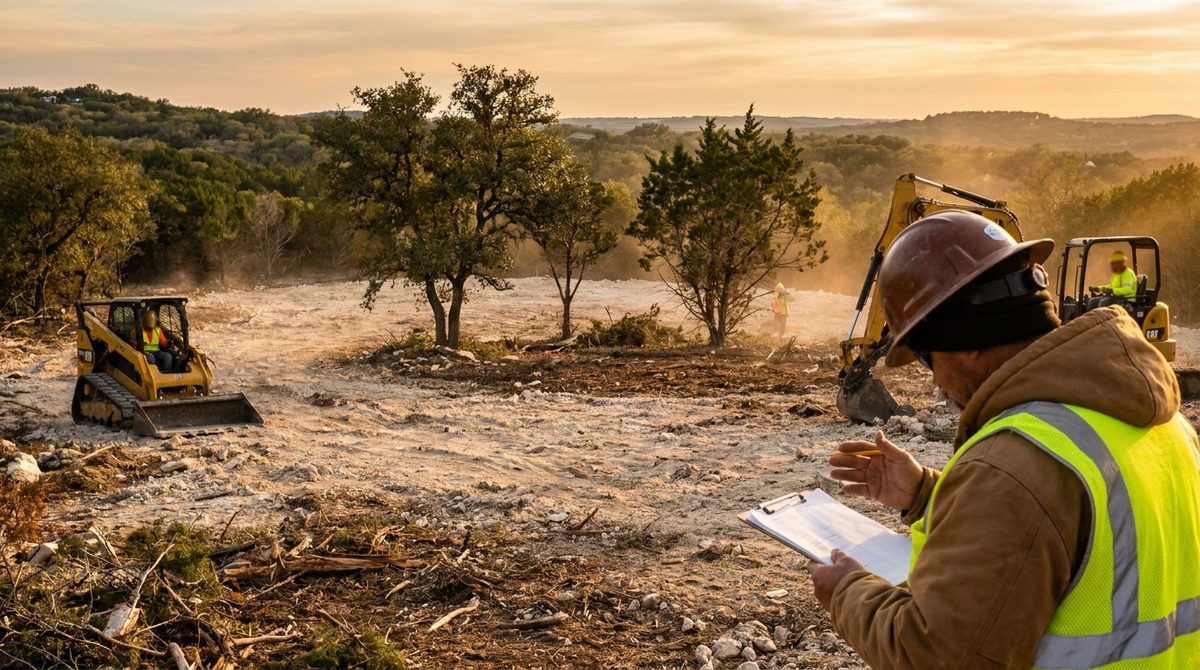
Many homeowners have no idea what to expect when the first wildfire prevention quote comes in. Defensible space clearing doesn't have a standard rate — what you pay depends on what's on your property, how much of it needs to be cleared, and what compliance requires. Understanding what drives the cost before you start calling contractors is how you budget accurately and recognize whether a quote is complete.
// In This Guide
// 01 Why Wildfire Prevention Can't Be Priced Without a Site Visit
Defensible space clearing is priced based on what's on the land — and that varies too much between properties to quote accurately without seeing it. Vegetation density, terrain, zone requirements, and compliance obligations all affect both the scope and the cost.
⚠ What This Means for You
A contractor who gives you a number over the phone without visiting the property is guessing — or padding the quote to cover the unknowns. ClearGround's process starts with an RTK drone pre-scan that maps vegetation density, structure proximity, and zone requirements before we price anything. That's what allows us to give you a fixed-price bid, not an estimate that changes once work begins.
// 02 What Goes Into a Wildfire Prevention Quote
Five variables drive nearly all the price difference you'll see between properties of similar size. Here's how each one moves the number.
Acreage and Zone Requirements
Defensible space clearing is primarily priced by the acre. How much acreage falls within your required buffer zones depends on your property size, where structures sit on the lot, and what the local wildfire guidelines specify. A property with structures close to the property boundary may have a smaller clearable zone than one with more setback — even at the same total acreage.
Vegetation Type and Density
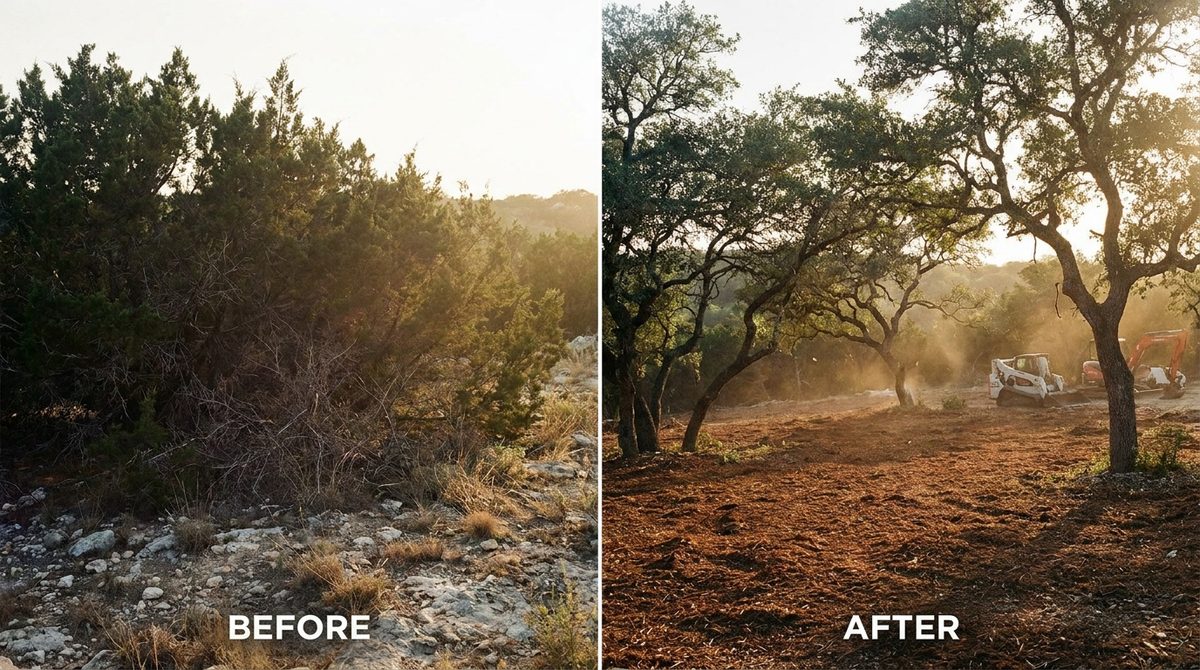
Light brush clears considerably faster than dense cedar, mesquite, or thick overgrowth. In Central Texas, Ashe juniper (cedar) spreads aggressively and forms dense thickets that require significantly more time per acre to process. In Utah's WUI zones, Gambel oak and scrub brush present similar challenges. The heavier the growth, the higher the cost per acre — and the difference between light and heavy density can be 2–3x on the same acreage.
Terrain and Slope
Steep or uneven terrain slows equipment and affects how aggressively each buffer zone needs to be cleared. A flat, open property will clear faster than a hillside — and on steeper slopes, zone clearance specifications are typically more stringent because fire travels uphill faster. Hill Country escarpments and Wasatch Front slopes both present this compounding effect.
Compliance Documentation
In states with defensible space mandates — Utah's HB 48 being the clearest example — documentation is part of the job, not optional. RTK-verified clearing records qualify for fee reductions and satisfy insurance requirements. This adds cost to the project, but it's the cost of the job being done properly. Always confirm whether documentation is included in your quote before signing.
First Clear vs. Annual Maintenance
The first time a property is cleared will always be the most expensive pass. Decades of vegetation growth takes more time and effort to process than a maintenance pass on a previously cleared property. Annual maintenance to keep buffer zones effective should cost considerably less — but it needs to be treated as a recurring budget item, not an optional follow-up.
// 03 Cost Ranges by Market and Site Type
These ranges are based on Austin TX, Texas Hill Country, and Salt Lake City / Wasatch Front market conditions. They are starting frameworks — not substitutes for a site-specific assessment.
"The documentation is part of what you're paying for — not an upgrade. When your insurer asks for proof of defensible space, you don't send photos. You send a link to a geo-referenced 3D model."
— ClearGround, Austin TX · Salt Lake City UT
// Interactive Tool
Wildfire Prevention Cost Estimator
Get a rough ballpark for your property. This is a starting point — not a quote. A site visit is required for accurate pricing and documentation scope.
// Estimated Project Range
// Estimates based on Austin TX, Hill Country, and Salt Lake City / Wasatch Front market conditions. Actual cost depends on site-specific conditions assessed during RTK pre-scan. This tool is not a quote.
// 04 The Documentation Cost — and Why It Matters
Documentation is the line item most homeowners don't think to ask about — until they need it.
// HB 48 and Insurance Documentation
Under Utah's HB 48, defensible space clearing must be documented to qualify for fee reductions and satisfy insurance carrier requirements. "Documented" means a verifiable record — not photos on your phone. A geo-referenced 3D model with timestamped before/after comparison and zone measurements is what compliance requires.
In Texas, Firewise certification and insurance carrier requirements are increasingly pushing in the same direction. Insurers in high-risk Hill Country zip codes are asking for more than verbal confirmation of defensible space. RTK-verified documentation protects your coverage and your claim.
When comparing quotes, confirm explicitly: is RTK documentation included in this price? If a contractor doesn't mention it, that doesn't mean it's included — it usually means it isn't.
Not sure what your property's defensible space requirement looks like? ClearGround's RTK pre-scan maps your zones before we quote — no guesswork on scope or price.
Book a Free Site Scan →// 05 Annual Maintenance: Budget for It Up Front
// Defensible Space Is Not a One-Time Project
Vegetation grows back. Fuel loads rebuild. The first clearing establishes your defensible space — annual or biannual maintenance keeps it effective and your documentation current.
The first pass will always be the most expensive, because you're processing years of accumulated growth. Annual maintenance on a previously cleared property should run 30–60% less per acre than the initial clear. Budget for it as a recurring line item, not an optional follow-up.
ClearGround offers annual and biannual maintenance plans that include updated RTK documentation on each visit — so your compliance records stay current without a new mobilization quote every year.
// 06 Before You Sign Anything
A vague quote will change. Here's what every wildfire prevention quote should specify before you commit.
Wildfire Prevention Quote Checklist
- Acreage to be cleared, specifically defined — not "the defensible space area"
- Clearing method stated: forestry mulching, manual clearing, or both
- Whether debris disposal / haul-off is included or separate
- Whether RTK documentation is included — and what format it's delivered in
- Which zone specifications the clearing will meet: NFPA, Firewise, HB 48
- How preserved trees and vegetation will be identified and protected
- Clear project timeline and mobilization date
- Whether annual maintenance is available and at what rate
// Frequently Asked Questions
How much does defensible space clearing cost?
In Austin TX, Hill Country, and Salt Lake City, defensible space clearing typically ranges from $1,500 to $5,500 per acre depending on vegetation density, terrain, zone requirements, and whether documentation is included. Annual maintenance on a previously cleared property costs considerably less. A site visit is required for accurate pricing.
Is RTK documentation included in wildfire prevention quotes?
Not always — and this is the most important item to confirm before signing. In Utah under HB 48, documentation is legally required. In Texas, insurers increasingly require verified records. Always ask explicitly whether RTK documentation is included in the quoted price or treated as a separate line item.
Does defensible space clearing need to be done every year?
Yes. Vegetation grows back and fuel loads rebuild over time. The first clearing is the most expensive. Annual maintenance to keep buffer zones effective and documentation current should cost 30–60% less per acre than the initial clear. Treat it as a recurring expense from the start.
What's included in a good wildfire prevention quote?
Acreage specifically defined, clearing method, disposal, RTK documentation scope, zone compliance specifications (NFPA / Firewise / HB 48), how preserved vegetation will be protected, project timeline, and annual maintenance availability. A quote missing any of these items is incomplete and likely to change.
// Ready for a Real Number?
Scanned Before Quoted.
Documented When Done.
ClearGround's RTK pre-scan maps your defensible space zones before we price anything. Fixed-price bid. Documentation included. No surprises.
Book a Free Site ScanServing Austin, TX · Texas Hill Country · Salt Lake City, UT