


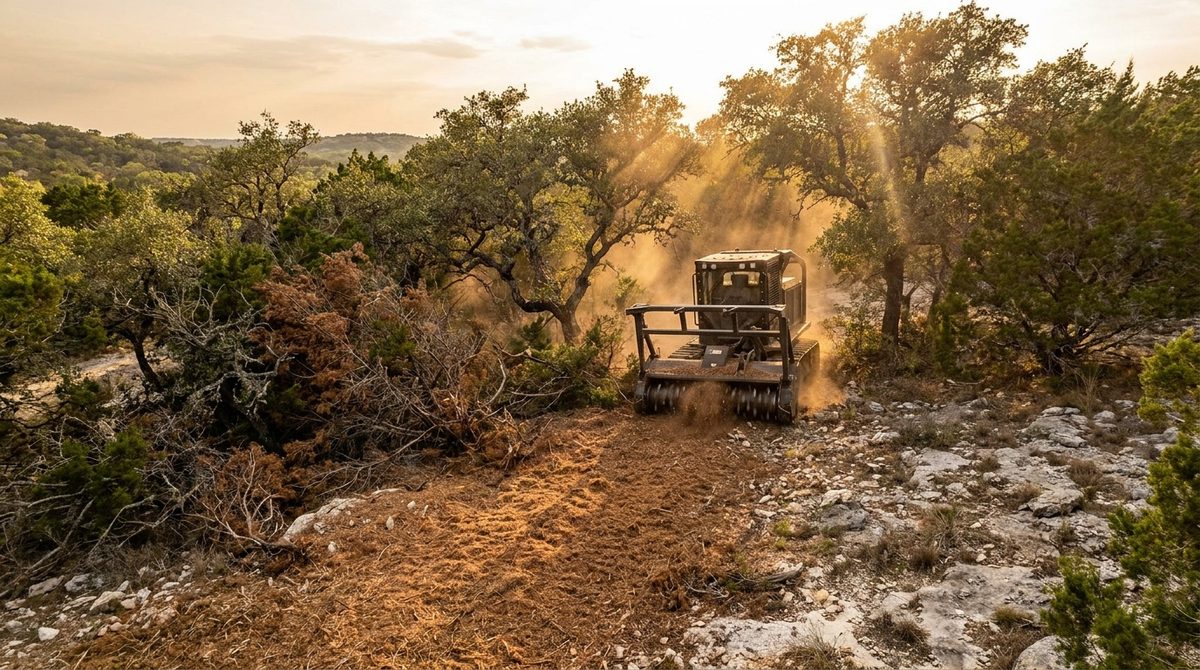
Forestry mulching is one of the most effective and environmentally responsible ways to clear land — and it's one of the least understood. Whether you're reclaiming an overgrown residential lot or preparing a development site for construction, knowing how forestry mulching differs from traditional land clearing can save you time, money, and a significant amount of coordination headache.
// In This Guide
// 01 What Forestry Mulching Actually Is
// Definition
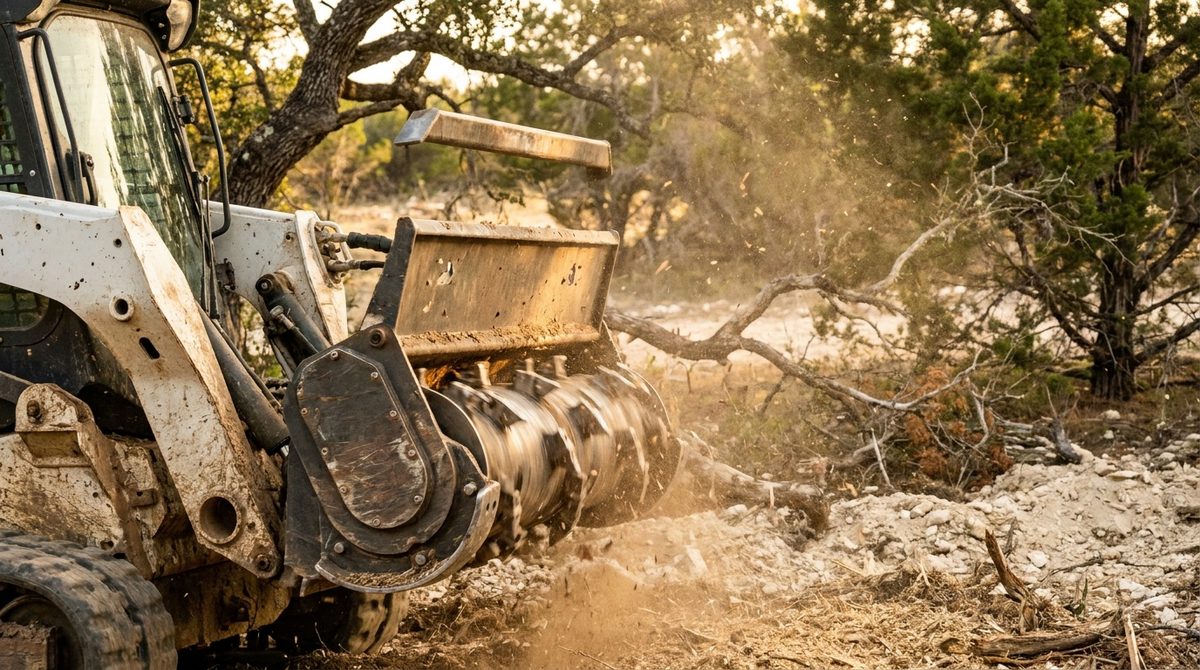
Forestry mulching is a single-machine, single-pass land clearing process. A specialized machine with a rotary drum head moves through the property — cutting down trees, brush, stumps, and undergrowth, then grinding everything into mulch in the same pass. The mulched material stays on site as a natural ground cover. Nothing is hauled off, burned, or pushed into piles.
That last part — what stays on site — is what makes the whole method work. The mulch layer that's left behind after the machine passes isn't a byproduct or a compromise. It's an active part of what makes forestry mulching better for your land than the alternatives.
// 02 Six Benefits Over Traditional Land Clearing
Traditional land clearing — bulldozers, burn piles, haul-off trucks — involves multiple pieces of equipment, multiple crews, and a lot of coordination. Forestry mulching replaces most of that with one machine and one pass. Here's what that means in practice.
One Machine. One Pass.
Traditional clearing requires a convoy — bulldozers, excavators, dump trucks, and sometimes burn crews. Forestry mulching handles all of it in a single pass with a single machine. That means a faster timeline, a lower total cost, and far fewer moving parts to coordinate before your project can move forward.
Faster TimelineNo Debris Hauling or Disposal Costs
Because the mulched material stays on site, haul-off costs are eliminated entirely. On large-scale clearing projects, disposal costs add up quickly — sometimes matching or exceeding the clearing cost itself. Forestry mulching removes that line item from your budget completely.
Zero Haul-OffProtects and Improves the Soil
Bulldozing and burning strip topsoil and leave the ground bare and exposed — making erosion a serious problem, especially on sloped or uneven terrain. The mulch layer left by forestry mulching does the opposite: it holds moisture in, slows erosion, and breaks down over time in a way that actively improves the soil. On Hill Country properties with slopes or drainage sensitivities, this isn't a minor benefit — it's often the deciding factor.
Erosion Reduced Up to 80%Selective Clearing — Precision at the Tree Level
Forestry mulching gives you precise control over what gets removed and what stays. The machine can work around mature oaks, specific vegetation, natural buffers, or any trees you want to preserve. A bulldozer doesn't offer that — everything in its path is cleared. In Austin, where the Heritage Tree Ordinance protects specimen trees by ordinance, this level of precision isn't optional — it's legally required.
Heritage Tree SafeMinimal Site Disturbance
Because forestry mulching doesn't require heavy dozer work or multiple equipment passes, the disruption to surrounding areas is significantly less. The machine moves through once, clears what needs to go, and leaves everything else untouched. Neighboring properties, existing landscaping, and site access routes stay intact throughout the job.
Faster Permitting and Environmental Compliance
Burning debris requires burn permits, and hauling to a landfill requires disposal permits — both vary by jurisdiction and can add weeks to a project timeline. Because forestry mulching processes everything on site, it typically avoids both. No burn restrictions to navigate, no hauling permits to pull, no TCEQ compliance issues from open burning. Less paperwork means faster starts.
No Burn Permits Required"The mulch layer isn't a side effect — it's doing active work. Holding moisture, slowing erosion, feeding the soil. Your land is measurably healthier after we leave than before we arrived."
— ClearGround, Austin TX · Hill Country · Salt Lake City UT
// 03 Side-by-Side: Forestry Mulching vs. Traditional Clearing
Wondering how forestry mulching fits your specific site? We scan every property before quoting — you see exactly what we'll clear before we start.
Book a Free Site Scan →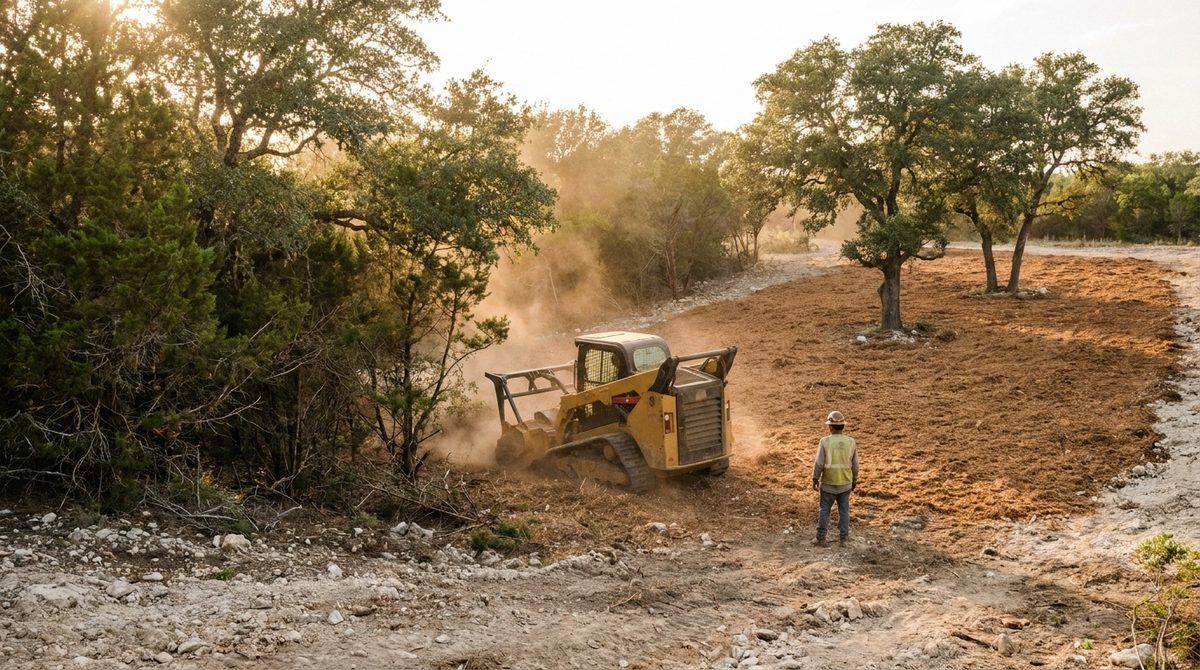
// 04 Is Forestry Mulching Right for Your Property?
Forestry mulching fits a wide range of projects — but it's not the only tool. Here's a plain-language breakdown of where it excels and where other approaches might be better suited.
- Overgrown residential lots with cedar, brush, or mesquite
- Development sites that need vegetation cleared before grading
- Properties creating wildfire defensible space (30–100' perimeter)
- Lots with trees you want to preserve alongside areas being cleared
- Sites where access routes and neighboring properties need to stay intact
- Rural land with dense undergrowth and uneven terrain
- Properties where burn restrictions or haul-off costs are a concern
- Trees significantly larger than 12 inches diameter (may need excavator assist)
- Sites requiring bare-dirt grading immediately after clearing
- Tap-root species like mesquite that may require follow-up herbicide treatment
- Commercial-scale clearing over 5+ acres where high-HP mulchers have a throughput advantage
- Sites with significant existing concrete, debris, or non-organic material that needs removal
The denser the brush, stumps, and undergrowth, the stronger the case for forestry mulching over traditional clearing. On most residential and light development sites in Austin and the Hill Country — where cedar, live oak, and limestone interact in ways that break conventional clearing equipment — it's usually the right first call.
// Go Deeper More on ClearGround's Forestry Mulching
These pages cover the specific equipment, technology, and process ClearGround uses — including the RTK pre-scan and before/after digital twin.
// Frequently Asked Questions
What is forestry mulching?
Forestry mulching is a single-machine, single-pass land clearing process. A specialized machine with a rotary drum cuts trees, brush, stumps, and undergrowth while grinding everything into mulch in the same pass. The mulched material stays on site as natural ground cover — nothing is hauled off, burned, or pushed into piles.
What are the main benefits of forestry mulching over traditional land clearing?
Faster timeline (one machine vs. multiple crews), no haul-off or disposal costs, better for soil (mulch layer prevents erosion and retains moisture), selective clearing precision around trees you want to keep, less site disruption, and typically fewer permits than methods involving burning or hauling.
How much does forestry mulching cost in Austin, TX?
In Austin and the Texas Hill Country, forestry mulching typically ranges from $1,500 to $5,000 per acre depending on vegetation density, slope, terrain, and access. Sites with heavy cedar, mesquite, and limestone outcroppings run toward the higher end. A site assessment is required for accurate pricing.
Will cleared brush grow back after forestry mulching?
Many species are effectively controlled by mulching. However, tap-root species like mesquite may require a follow-up herbicide application or traditional clear-and-grub technique to prevent regrowth. ClearGround assesses regrowth risk during the pre-scan walkthrough and advises accordingly.
Can forestry mulching work on steep Hill Country slopes?
Yes. Tracked mulching machines are purpose-built for the rugged, uneven terrain common across the Balcones Escarpment and Hill Country. ClearGround's equipment is specifically suited for Austin-area slope conditions.
// Ready to Clear Your Property?
Scanned Before We Cut.
Documented When We're Done.
Every ClearGround forestry mulching project starts with an RTK drone pre-scan and ends with a 3D digital twin of what was cleared. No guesswork. No surprises.
Book a Free Site ScanServing Austin, TX · Texas Hill Country · Salt Lake City, UT