


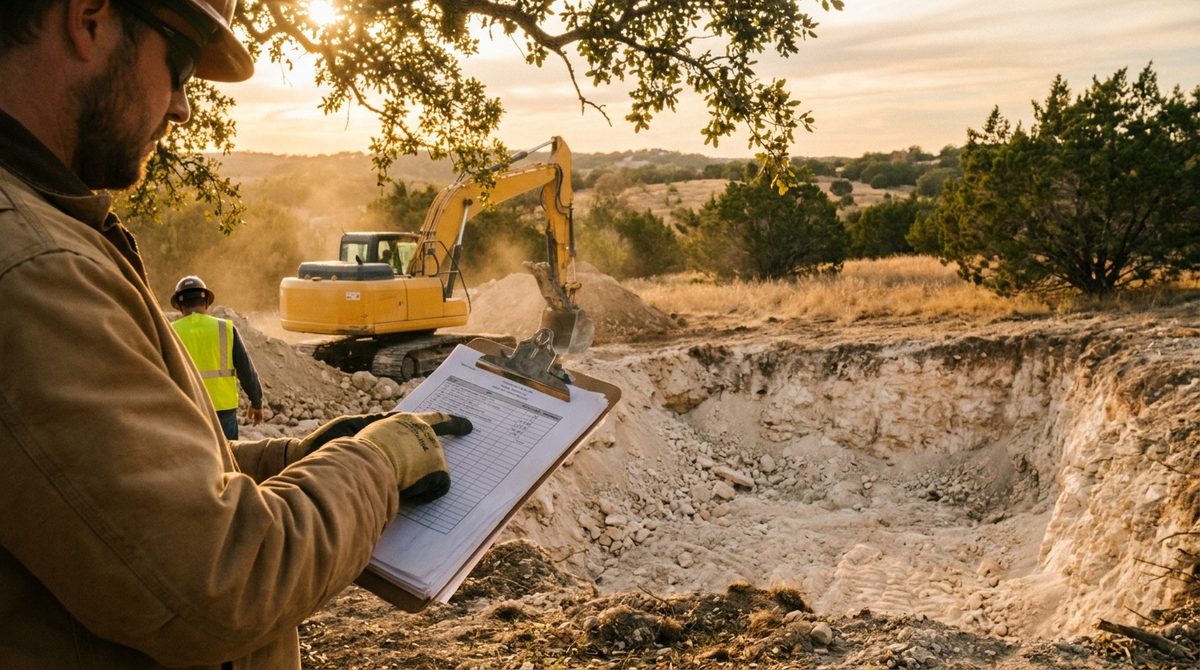
Foundation excavation runs $15,000–$28,000 per structure. Rock adds $35–$90 per cubic yard. Trenching runs $5–$40 per linear foot. Two projects that look alike can land thousands apart, and both quotes can be honest. The reasons are below.
In this guide
What does excavation cost in Austin?
These are our own ranges. Each row links to the service page. For foundations, see foundation excavation. For utility lines, see trenching.
| Project | Unit | Range | What moves it |
|---|---|---|---|
| Foundation excavation | per structure | $15,000–$28,000 | Depth, footprint, rock, access |
| Rock, rippable | per cubic yard | $35–$45 | Caliche and soft rock a machine can rip |
| Rock, hammer | per cubic yard | $65–$90 | Hard limestone, hammer hours |
| Utility and drainage trenching | per linear foot | $5–$40 | depth and rock drive the price |
| Pool shell excavation | per pool shell | $4,500–$28,000 | Shell size, rock, access (range from our pool excavation page) |
| Grading and drainage | per lot | $2,500–$8,000 | to $12,000+ with rock |
| Pad and site prep | per lot | $12,000–$22,000 | to $30,000 with rock and engineered fill |
| Land clearing | per acre | $3,000–$8,500 | grub, haul and prep |
Prices reviewed: September 2026. Ranges for Austin and Central Texas; your site walk sets the final number.
See pricing. Full rate ranges are on our pricing page. To size your own job, use the excavation calculator.
How does measured volume change a quote?
Excavation is billed by the cubic yard on many jobs, so the volume number matters. This is an example, not a quote. It is plain arithmetic.
Example: 40 ft x 30 ft dig through rock that needs a hammer
| Basis | Depth | Math | Cubic yards | At hammer rate, low | At hammer rate, high |
|---|---|---|---|---|---|
| Estimated by eye | 5 ft | 40 x 30 x 5 / 27 | 222.2 | $14,444 | $20,000 |
| Measured (surface scan before and after) | 4 ft average | 40 x 30 x 4 / 27 | 177.8 | $11,556 | $16,000 |
| Difference | 44.4 | $2,889 | $4,000 |
A one-foot guess on depth moves the bill by that difference. Scanning the ground surface before and after the dig and comparing the two surfaces settles the volume. It is an optional add-on ($500–$1,500 per scan), never required. RTK-corrected drone photogrammetry, checked against ground points on site. Our drone scans measure surfaces, quantities and grades. They are not a boundary survey or a sealed survey by a licensed surveyor, and a drone cannot see below the ground surface.
Why can't excavation be priced without seeing the site?
There is no flat rate and no reliable per-square-foot average. The price depends on what is in the ground, how deep the dig goes and how equipment reaches the site.
What this means for you
A firm price over the phone is a guess or a padded number. The unknowns come back as change orders once the crew is on your lot.
What drives excavation cost?
Five variables explain most of the gap between bids.
Ground conditions
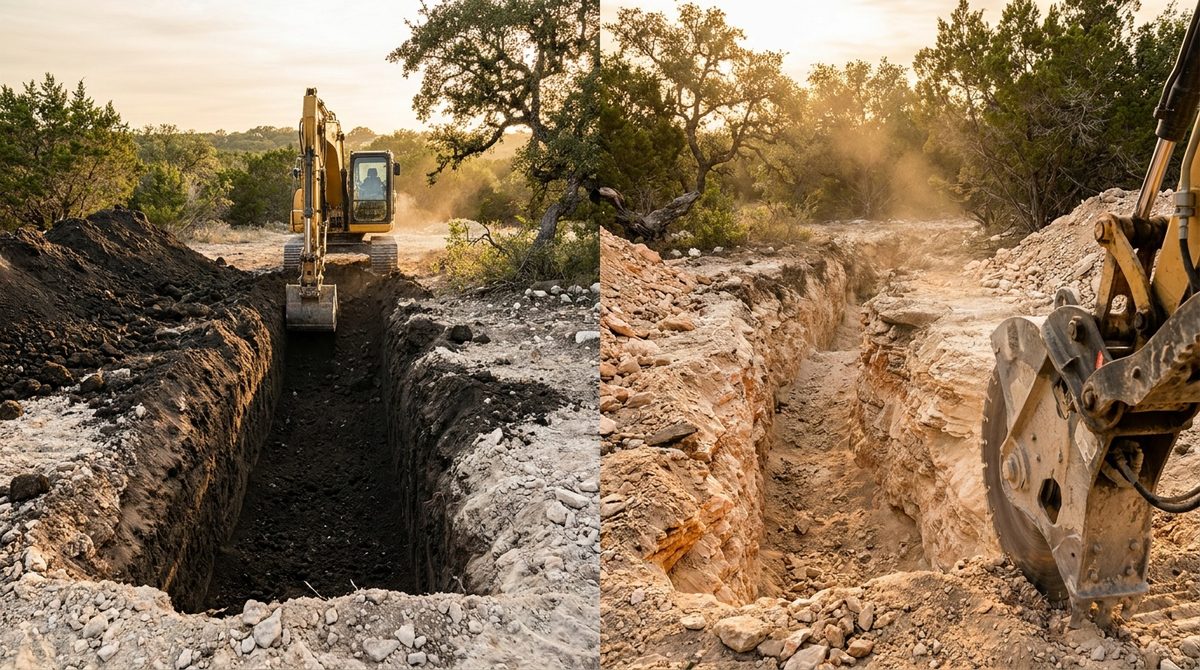
The biggest variable. Limestone, caliche and dense clay take specialized equipment and more time per cubic yard than soft soil. Rock is common in the Hill Country. A drone models the ground surface. Rock, footings and buried lines below the surface are found with test holes, probing, 811 locates and GPR where needed.
Volume of material
A deeper foundation or bigger shell means more yards moved. Small changes in depth or width shift the total quickly.
Pricing model
Hourly rates give flexibility on unpredictable scopes. Cubic-yard pricing gives certainty on defined ones. Know which your quote uses.
Disposal and haul-off
Material reused on site for fill saves haul-off. Rock that has to leave adds to the total. Vague quotes often omit this line.
Lot access
Open sites allow bigger machines. Tight lots need compact equipment that moves slower. Narrow gates, slopes and overhead lines all belong in the quote.
Hourly or per cubic yard?
Hourly rate
You pay for equipment and crew time. The total depends on what the crew finds underground.
Cubic-yard pricing
You pay a rate per yard moved. The total follows the volume, which gives more predictability.
Either way, ask for an estimated total. A range built from best and worst case is fair. No estimate at all is a red flag.
Not sure which model fits? We will walk the site and quote it line by line.
Get a site assessmentWhat should a good excavation quote include?
Quote review checklist
- Depth and final dimensions
- How rock is handled and priced if conditions change
- Disposal method and whether haul-off is included
- Grading scope, if any
- Timeline, mobilization and standby fees
- Pricing model: hourly or per cubic yard
- How change orders are triggered and priced
What are the red flags in excavation pricing?
A quote that seems unusually low
Ground conditions, disposal or access are usually what got left out. Ask what the low bid does not include.
No questions about ground conditions
Central Texas has limestone and caliche near the surface in many places. A contractor who never asks about rock is not pricing your job.
Hourly rates with no estimated total
You cannot budget or compare without a range.
Common questions
How much does foundation excavation cost?
Foundation excavation runs $15,000–$28,000 per structure. Depth, footprint, rock and haul-off move the number, so a site walk sets the final figure.
How much does rock excavation cost per cubic yard?
Rippable rock such as caliche runs $35–$45 per cubic yard. Rock that needs a hydraulic hammer runs $65–$90 per cubic yard.
How much does trenching cost per linear foot?
Utility and drainage trenching runs $5–$40 per linear foot (depth and rock drive the price).
How much does pool excavation cost?
Pool shell excavation on our pool excavation page runs $4,500–$28,000, depending on shell size, rock and access.
Why are excavation quotes so different from contractor to contractor?
Contractors price risk and unknown ground differently. A low quote often leaves rock, disposal or access out, and it comes back as a change order.
Is excavation priced per hour or per cubic yard?
Both are used. Hourly suits small or unpredictable jobs. Cubic-yard pricing gives more certainty on well-defined jobs. Ask for an estimated total either way.
What should an excavation quote include?
Depth and dimensions, how rock is handled and priced, disposal and haul-off, grading scope, mobilization and timeline, and how change orders work.
Ready for a real number?
Every quote starts
with a site walk.
Our quotes are line-itemized and site-specific. Written quote within 48 hours of the site walk.
Get a free site assessmentAustin, the Texas Hill Country and Central Texas