


Selective Clearing & Heritage Tree Rules in Austin
Clear what needs to go. Protect what the city requires.
Clear Ground clears Austin lots around protected and heritage trees. Selective clearing runs $5,000–$12,000 per site, usually one to four days on site. It covers flagging root zones, clearing everything else, and a before-and-after photo record for the city. This page also lays out Austin's tree thresholds, permits and root-zone rules.
What size tree does Austin protect?
Austin protects trees by trunk diameter, measured 4.5 feet above natural grade. A protected tree is 19 inches or larger, any species. A heritage tree is 24 inches or larger and one of the listed species below. These rules sit in the City's Land Development Code (LDC) Section 25-8-621 (protected trees) and Section 25-8-641 (heritage trees). The City Arborist administers them.
| Class | Size | Species | What it means |
|---|---|---|---|
| Protected tree | 19" and up | Any species | Removal or root-zone impact needs City review and a permit |
| Heritage tree | 24" and up | Listed species only | Removal needs a variance, and is allowed only for reasons the code lists |
| Large heritage tree | 30" and up | Listed species only | Removal variance goes through a public process |
There is no separate tier below 19 inches. Multi-trunk trees are measured by the City's formula, so have the Arborist confirm anything close to the line. Last reviewed: September 2026.
Which trees count as heritage trees in Austin?
A tree that reaches 24 inches and belongs to one of these groups is a heritage tree:
- Texas ash
- Bald cypress
- American elm
- Cedar elm
- Texas madrone
- Bigtooth maple
- All oaks (live oak, Shumard, post oak, Texas red oak and the rest)
- Pecan
- Arizona walnut
- Eastern black walnut
Ashe juniper (cedar) is not on the heritage list. A cedar over 19 inches is still a protected tree. Source: City of Austin, City Arborist; LDC 25-8-641 and Environmental Criteria Manual (ECM) Appendix F.
Last reviewed: September 2026.
How close can a machine work to a protected tree?
The critical root zone (CRZ) is the ground around a trunk where roots feed the tree. Its radius is one foot per inch of trunk diameter. A 24-inch oak has a 24-foot CRZ radius.
The rules for working in the CRZ come from ECM Section 3.5.2. Limited work is allowed. It is not a no-work zone. The main limits are:
Keep at least 50 percent of the full CRZ undisturbed, at natural grade with its natural ground cover. No cut or fill over 4 inches closer to the trunk than half the CRZ radius. Nothing goes in the inner quarter of the CRZ. That means no digging, no fill, no equipment, no stockpiles and no trailer. City staff can ask for a larger protected area for sensitive species such as post oak.
Compaction counts. Parking a skid steer or piling mulch on roots can hurt a tree without a cut. We flag the zones on the ground before the machine starts, and the operator works to the flags.
Do I need a permit to clear around a tree in Austin?
If you are building, tree review runs with the building plan review, and the tree permit comes with the building permit. If the work is not tied to a building permit, the City asks for a Tree Ordinance Review Application (TORA). Either way, the City Arborist decides whether the plan protects the trees. Clearing brush, cedar and small trees away from any protected tree's root zone usually needs no tree permit. Clearing that reaches a protected tree's root zone does.
Removing a heritage tree needs a variance. Variances for heritage trees under 30 inches go through an administrative review (LDC 25-8-642). Variances for trees 30 inches and up go through a Land Use Commission public process (LDC 25-8-643). Dead, diseased or hazardous trees follow a different track, so ask the Arborist before you assume either way.
Mitigation. When a protected or heritage tree is removed with approval, the City requires replacement plantings or a payment into the Urban Forest Replenishment Fund. Heritage trees carry a higher ratio than protected trees. The City's June 2025 Environmental Commission presentation lists 1:1 for protected trees, 3:1 for heritage trees, and a fund payment per inch as the alternative. Confirm the current ratio and rate with the Arborist before you budget.
Enforcement. Damage to a protected tree's root zone or an unpermitted removal can bring a stop-work order and mitigation. The amount depends on the trees and the case. We do not quote penalty figures. Ask the City Arborist.
This is a summary, not legal advice. Last reviewed: September 2026.
Do the same tree rules apply outside Austin?
No. Austin's ordinance applies inside Austin city limits. Nearby cities write their own rules. West Lake Hills, Rollingwood, Bee Cave and Lakeway each have their own tree or vegetation regulations. Other cities, including Round Rock and Pflugerville, set their own rules. Unincorporated Travis County land is generally outside all of them. Check the city that holds your address before you clear. We can tell you who to call.
Last reviewed: September 2026.
When is it safe to cut or prune near oaks?
Oak wilt kills live oaks and red oaks. Sap beetles carry the fungus to fresh wounds, and they are most active in late winter and spring. Texas A&M Forest Service advises avoiding pruning or wounding oaks from roughly February through June, and painting every oak wound right away in any season. The best pruning window is generally November through January.
On selective jobs we keep machines off oak trunks and roots, schedule oak-adjacent cutting outside that window when we can, and paint any wound. Tell us on the first call if the lot has oaks.
Last reviewed: September 2026.
How much does selective clearing cost in Austin?
| Service | Unit | Range | Typical timeline |
|---|---|---|---|
| Selective clearing around protected trees | Per site | $5,000–$12,000 | 1–4 days on site |
| Root-zone flagging | Per site | Included with clearing | Before the first machine pass |
| Written tree map and photo record (root-zone flagging is included with clearing) | Per site | $800–$2,200 | Delivered after the job |
| Optional drone topo scan | Per scan | $500–$1,500 | Typically 2–3 business days after the flight |
Prices reviewed: September 2026. Ranges for Austin and Central Texas; your site walk sets the final number. Hauling debris off instead of mulching in place is priced separately. Arborist fees, if the City requires an assessment, are paid by you at the arborist's rate. See all pricing or the land clearing calculator.
Tree walk &
root-zone map
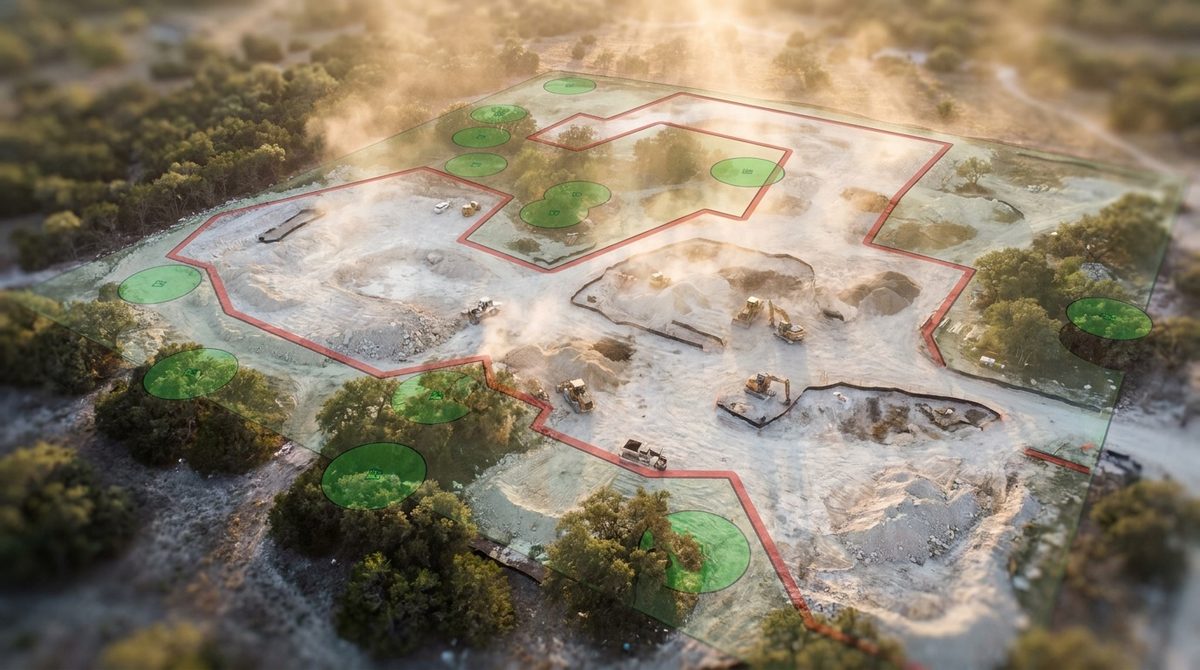
We walk the lot with you, tag every tree that might be protected, measure trunks at 4.5 feet and mark the root zones on a site map. That map decides where the machine can and cannot go. On larger sites we can add a drone scan of the surface to place the trees against your survey. The scan does not replace your surveyor or a City Arborist decision. Our drone scans measure surfaces, quantities and grades. They are not a boundary survey or a sealed survey by a licensed surveyor, and a drone cannot see below the ground surface.
Root-zone map on your site plan
Optional drone scan
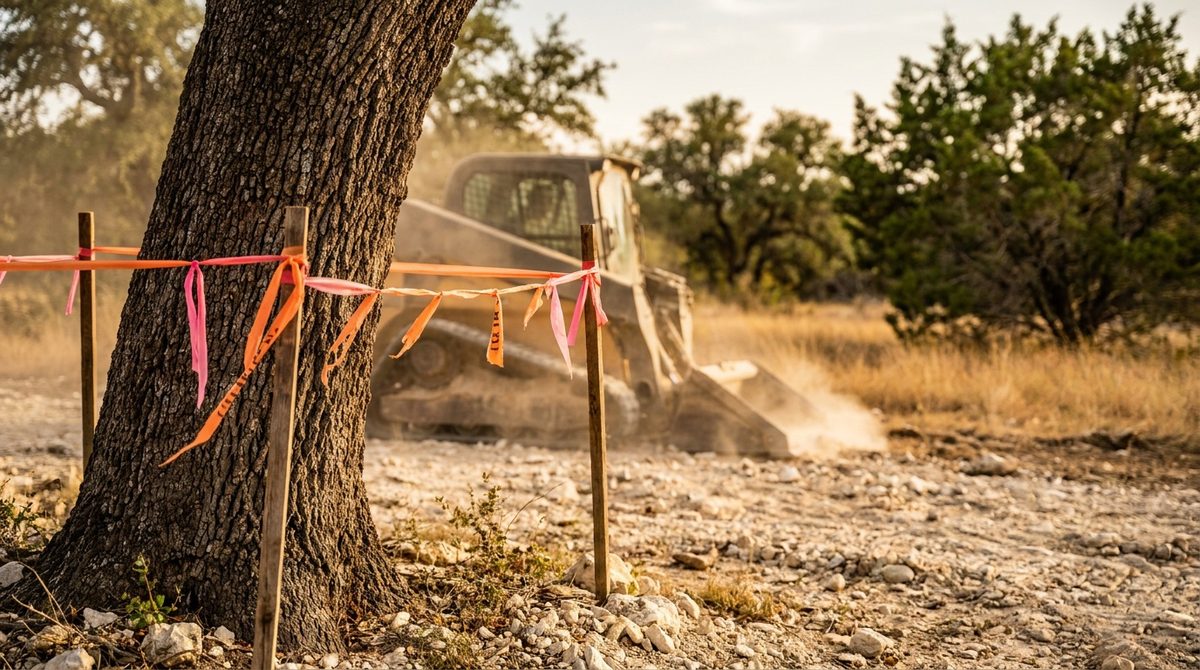
Root-zone flagging
Root zones are staked and flagged on the ground before clearing starts, and the operator walks them with us. The flag is the line. If a tight spot needs work inside a zone, we stay within the ECM 3.5.2 limits above, work by hand or with a smaller attachment, and get the Arborist's answer first when the permit calls for it.
Operator walk-through before mobilizing
Photo record of flagged zones
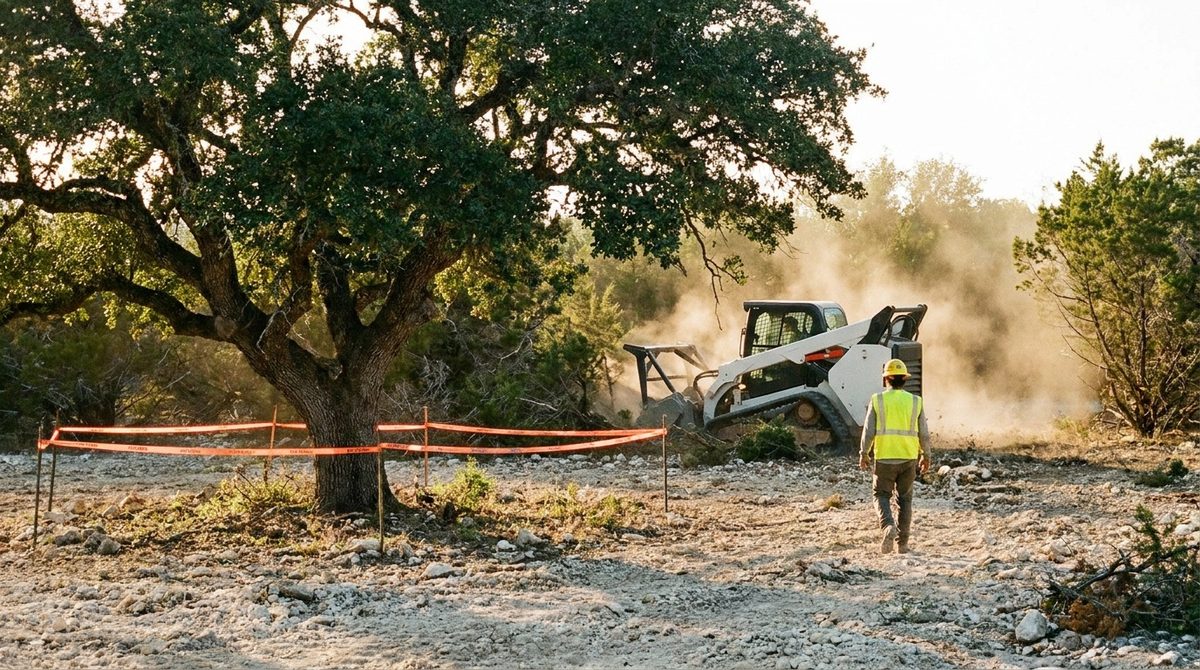
Selective clearing
Brush, cedar, invasive species and unprotected trees come out with a forestry mulching head, and the material is mulched in place or hauled off. Protected trees stay standing with their root zones intact. For tight spots we use the mini excavator instead of the larger machine.
CAT 305.5E2 mini excavator for tight spots
Mulched in place or hauled off
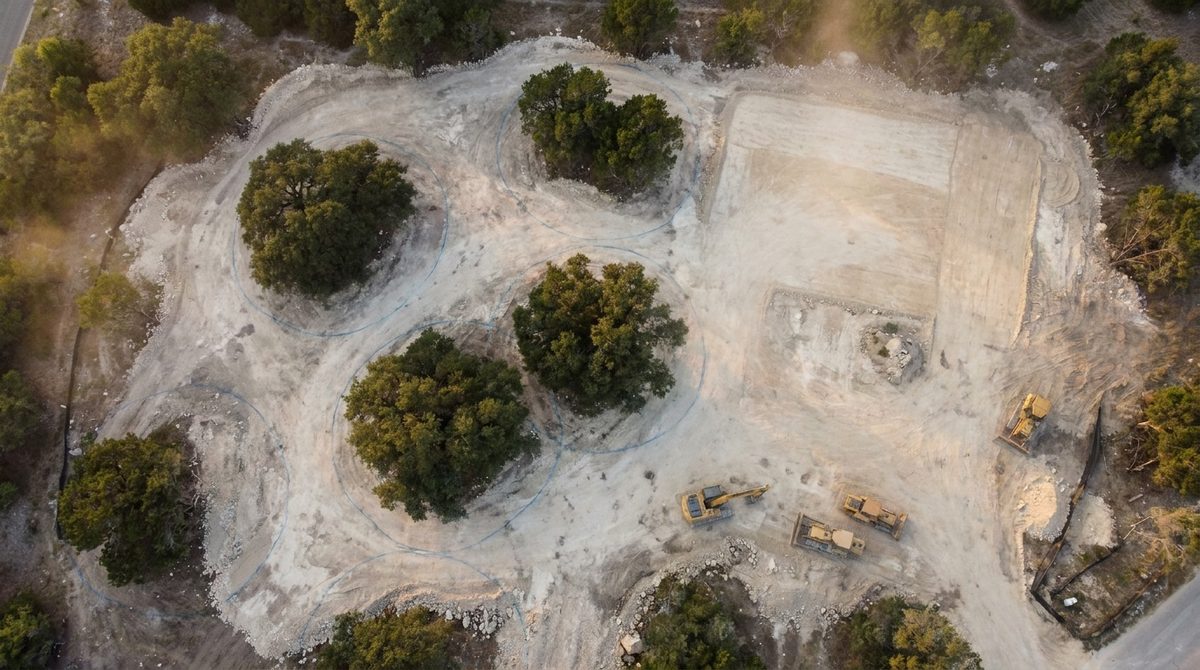
Documentation &
arborist coordination
We photograph the flagged zones before work and the trees after, and hand you the map and photo record for your permit file. We are not arborists. When the City requires a written assessment, a certified arborist writes it, and we coordinate with them and share our map and photos. You pay the arborist's fee.
Tree map with root zones
Coordination with your arborist
Who needs selective clearing?
Pool & estate builders
Hill Country lots are full of live oaks. A 24-inch oak 20 feet from the pool shell has a 24-foot root-zone radius, and that circle can overlap the dig, the staging area and the access path. We map those limits before your crew mobilizes.
Infill developers
Infill lots often have a protected tree sitting where demolition staging and the foundation need to go. Knowing the root-zone limits before you design the driveway saves a redesign. See the tight-lot excavation guide for digging near trees.
Austin tree rule questions
Know your trees
before you clear.
We answer the same business day. Written quote within 48 hours of the site walk. Call (512) 880-8888 or send the form.
Request a Quote