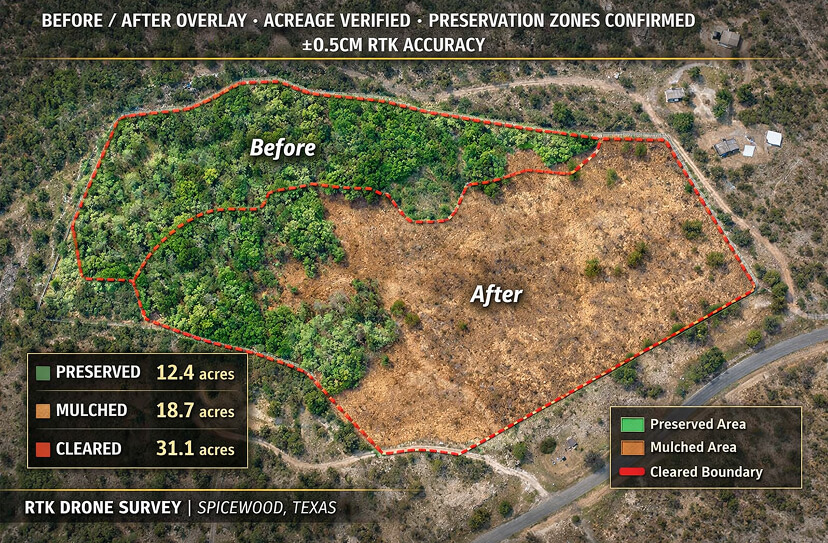
Light to medium vegetation. Large area. Fast passes. Drone-tracked every visit.
Forestry Mowing
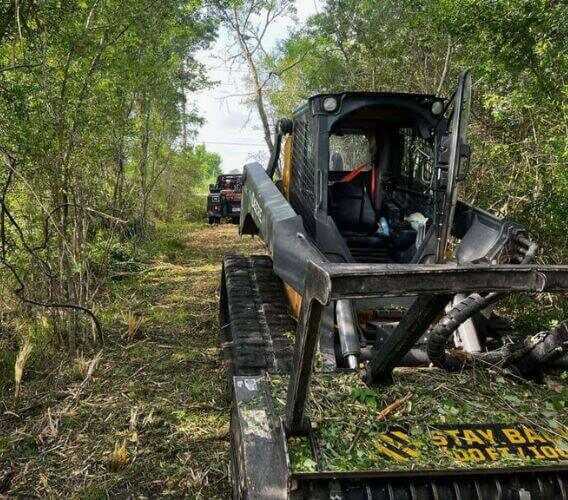
Forestry Mowing handles the lighter, faster end of vegetation management — overgrown fields, brush-encroached pastures, ROW corridors, and acreage that needs regular maintenance rather than one-time transformation. The CAT 299D3 XE with FAE head runs at higher pass speeds through lighter material, covering ground efficiently and returning mulch in place. Each visit is compared against the previous scan — so regrowth is targeted precisely, not the whole property again.
Large Area. Light Vegetation. Fast Passes. Recurring.
Forestry Mowing is the vegetation management scope for overgrown acreage at speed — lighter brush, encroaching cedar regrowth, field vegetation, and ROW corridors where the material is manageable and the goal is coverage over precision clearing. It sits below Forest Clearing & Land Preparation in scope intensity, and is the standard tool for recurring annual maintenance on cleared land.
Where This Fits
Forestry Mowing is appropriate when vegetation is light to medium — no mature canopy, no 6"+ trunk diameter trees requiring dedicated slower passes. For dense cedar stands or mature forest, that work belongs to Forest Clearing & Land Preparation. Forestry Mowing is commonly the annual follow-on service after an initial Forest Clearing — keeping cleared land from reverting while the first clearing handles the heavy work.
Forestry Mowing Is
What This Service Does
✓
Light to medium vegetation — brush, small cedar regrowth, brambles, field overgrowth, and woody stems under approximately 4–5" diameter
✓
High-efficiency pass speeds — 2–4 acres per day on light vegetation versus 0.5–1.5 acres per day on dense mature forest
✓
ROW and corridor maintenance — utility easements, power line corridors, fence lines, and pipeline access paths
✓
Recurring annual visits with scan-to-scan regrowth targeting — each visit tracked against the last survey so mowing is targeted, not blanket
✓
Defensible space maintenance — keeping previously cleared fire mitigation zones below fuel load thresholds between full clearing cycles
Forestry Mowing is the workhorse of recurring land management. The same equipment and method applies across a wide range of use cases — what changes is the terrain, the visit frequency, and what the land owner is managing toward.
Use 01
Annual Maintenance on Cleared Land
Cedar and brush cleared in a prior season will begin regrowing — Ashe Juniper in particular sends new growth from root crowns after cutting. Annual mowing visits keep that regrowth below the threshold where it becomes a full clearing job again. Scan-to-scan comparison targets precisely where regrowth has occurred rather than re-running the whole property.
Follows: Forest Clearing or Field & Brush Clearing
Use 02
Overgrown Field & Pasture Reclaim
Agricultural fields and pastures that have gone unmaintained for several growing seasons accumulate light brush, invasive species, and woody vegetation that reduces grazing value and access. Forestry Mowing reclaims those fields in one to two passes without a full forest clearing mobilization — when the vegetation is manageable, the faster scope is the right tool.
Power line corridors, pipeline easements, utility ROW, and access paths require periodic vegetation maintenance to keep clearance requirements and equipment access. Forestry Mowing covers long, linear corridor geometries efficiently — the CAT 299D3 XE's track and FAE head width are well-suited to standard ROW corridor dimensions and access point constraints.
See: ROW Maintenance section below
Use 04
Defensible Space Maintenance
After initial defensible space creation around a structure or community, annual or biannual mowing visits keep cleared zones below NFPA Firewise fuel load thresholds. The initial comprehensive clearing handles heavy cedar — Forestry Mowing keeps the maintenance zone managed between those full clearing cycles.
Follows: Wildfire Mitigation & Defensible Space
Use 05
Rural Property First Pass
Rural acreage that has been sitting unmanaged for 3–7 years often has recoverable overgrowth — not yet full forest, but too dense to use. A single Forestry Mowing visit can reclaim access, open pasture, and establish a baseline from which annual maintenance is manageable. The right scope for properties in transition, not yet at full forest clearing density.
May escalate to: Forest Clearing if density warrants
Use 06
HOA & Community Common Area Management
Hill Country HOAs and master-planned communities with undeveloped common areas, drainage easements, and buffer zones require recurring vegetation management to maintain appearances, fire codes, and deed restrictions. Forestry Mowing is the efficient recurring scope — one vendor, documented visits, scan-verified coverage for HOA records and insurance requirements.
Pairs with: Defensible Space maintenance plans
Speed by Terrain
What the Machine Encounters Determines the Rate
Forestry Mowing price and coverage rate are set by vegetation density, species composition, and terrain — not by acreage alone. The pre-visit site survey maps these variables so the quote is accurate before the machine leaves the yard.
Fastest
Open Field & Light Brush
Annual grasses, light brush under 2" diameter, intermittent woody vegetation, and field overgrowth on previously managed land. The FAE head runs at near-maximum speed. Typical profile for maintained rural acreage or annual maintenance visits on previously cleared land.
Coverage rate: 3–5 acres / day
$1,600 – $2,200
/ acre
What slows this down
Wet or soft soil after rain limits machine access and ground speed. Uniform terrain with no obstacles is the fastest possible condition — rocks, drainage features, or soft spots reduce efficiency.
Standard
Mixed Brush & Cedar Regrowth
Mixed light brush with cedar and juniper regrowth up to 3–4" diameter — typical of land cleared 2–4 years ago or pasture that has been partially managed. The FAE head processes the material but at slower pass speeds than fully open terrain.
Coverage rate: 1.5–3 acres / day
$1,800 – $2,400
/ acre
What slows this down
Thorny species like Huisache and Catclaw Acacia slow the head more than cedar of the same diameter. Dense multi-stem clusters require slower passes than single-trunk growth of equivalent biomass. Intermixed rock outcroppings require navigation around formations.
Heavier
Dense Brush & Thick Mesquite
Dense multi-stem brush stands, established Mesquite up to 5" diameter, and thickets unmanaged for 5–10+ years. Still within Forestry Mowing scope — but at the slower end of the rate range. Properties with Mesquite over 5" diameter may be better priced under Forest Clearing rates.
Coverage rate: 0.75–1.5 acres / day
$2,200 – $2,900
/ acre
What slows this down
Mesquite's multi-stem branching architecture tangles the FAE head significantly more than single-trunk cedar of equivalent diameter. Deep root crown regrowth after previous cutting creates dense, low-height stem clusters that are machine-intensive. Properties with Mesquite over 5" may be scoped under Forest Clearing rates for those zones.
ROW Specific
Corridor & Linear ROW
Power line corridors, pipeline easements, utility access paths, and road shoulders requiring vegetation control within a defined width. Priced per linear mile for corridor work — corridor width and vegetation density are the primary variables. Most ROW maintenance contracts are priced per linear mile on an annual basis.
Priced per linear mile — typical ROW 30–100 ft wide
$1,500 – $3,500
/ mile
What drives the price up
Corridor width is the primary variable — 100 ft wide ROW covers roughly 12 acres per mile, while a 30 ft corridor is closer to 3.6 acres per mile. Vegetation density within the corridor, access point frequency, and terrain slope all affect per-mile rate. Multi-year contracts reduce per-mile pricing significantly.
Video coming soon — Job Site Video — Forestry Mowing, Texas Hill Country
Right-of-way and utility corridor vegetation management is a repeating, contract-driven scope that benefits directly from the verification infrastructure built into every ClearGround job. Corridor clearing that gets documented — width verified, regrowth tracked, visits timestamped — protects the asset owner and the utility operator in ways that undocumented clearing cannot.
Why Documentation Matters for ROW
The Clearing Record Is Part of the Asset.
Utility operators and ROW managers need more than cleared ground — they need a record that the ground was cleared, when, to what width, and that vegetation limits were met. ClearGround's RTK drone survey after every ROW visit produces that record automatically: georeferenced corridor width, before/after overlay showing cleared zone, and a timestamped Digital Twin accessible via shareable link.
For multi-year ROW contracts, that record builds a documented maintenance history with scan-to-scan regrowth analysis — so the next visit targets exactly where regrowth has re-entered the corridor rather than re-running the full corridor every time. That efficiency improvement compounds across a multi-year contract.
Standard ROW Width
30–100 ft (varies by utility type and easement)
Equipment
CAT 299D3 XE + FAE Head — fits standard ROW access points
Before/after Digital Twin per visit, timestamped archive
Contract Structure
Annual, biannual, or per-visit — multi-year rates available
Pricing Basis
Per linear mile — quoted after site survey and corridor spec
Service Area
Austin metro, Texas Hill Country, Central Texas
Most Mowing Contractors Quote By Acreage and Show Up. We Map First.
The Forestry Mowing Process — Faster By Design
Phase 01
Pre-Visit Survey & Targeted Quote
The Quote Comes From the Vegetation Map.
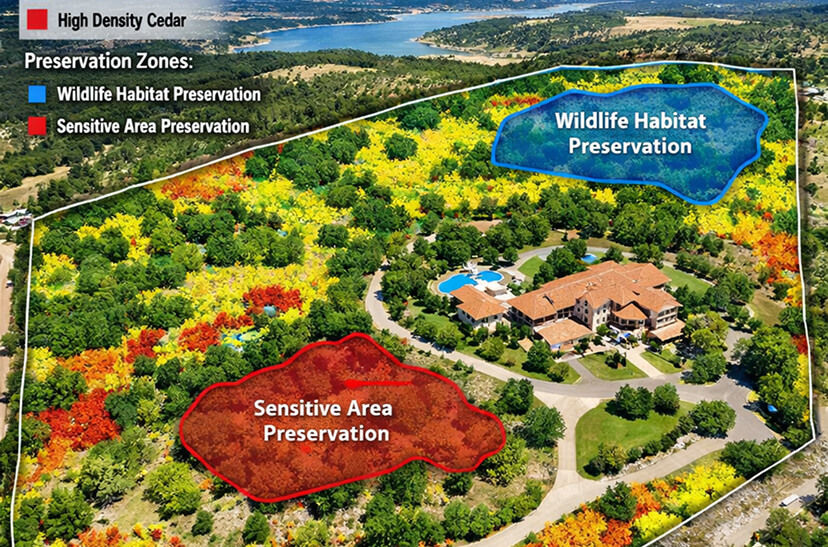
Before any mowing visit is scheduled, a drone survey maps the property's vegetation density by zone. Light brush zones, heavier accumulation areas, ROW corridor dimensions, and terrain conditions are all captured from above before a pass speed or per-acre rate is committed.
For first-time clients, this is the pre-quote site scan — the data that sets an accurate price before the machine leaves the yard. For existing maintenance clients, each revisit compares against the prior scan to identify exactly where regrowth has occurred, so the mowing scope is targeted rather than blanket coverage of the full property.
Vegetation Density by ZoneSpecies Composition IDROW Corridor Width VerificationRegrowth Delta from Prior ScanAccurate Per-Acre Rate from Data
Phase 02
High-Speed Mowing Execution
Fast Passes. Efficient Coverage. Material Returned.
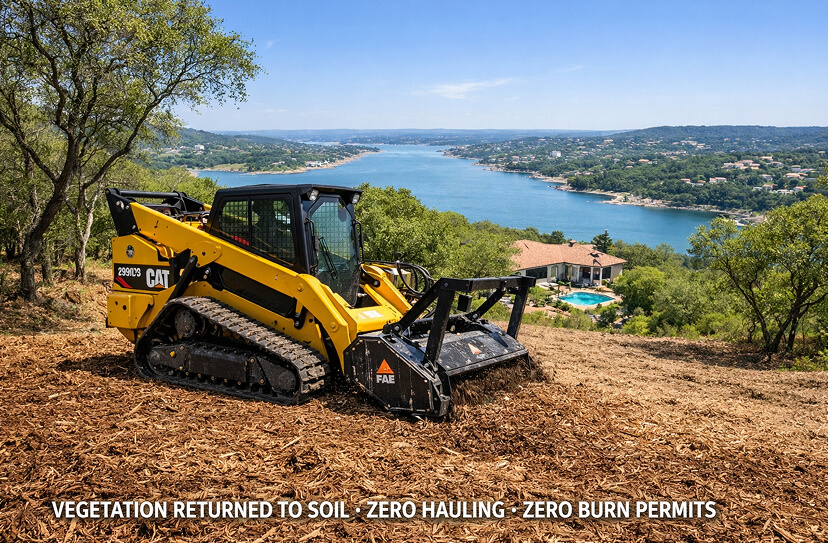
The CAT 299D3 XE with FAE head runs at higher pass speeds on lighter vegetation than the passes required for dense forest clearing. Light brush and cedar regrowth under 4–5" diameter is processed efficiently — material mulched in place at chip level, returned to the soil. No hauling, no burning, no secondary operations.
For ROW corridors, the machine runs systematic parallel passes within the corridor width defined in the pre-visit plan. For maintenance visits on irregular acreage, the operator follows the regrowth map from the prior scan — targeting areas that have actually grown back rather than making redundant passes over already-clear zones.
CAT 299D3 XEFAE Mulching Head2–4 Acres / Day (Light Veg.)Regrowth-Targeted PassesZero Hauling · Zero Burn Permits
Phase 03
Post-Visit Verification Scan
Every Visit Documented. Every Corridor Verified.
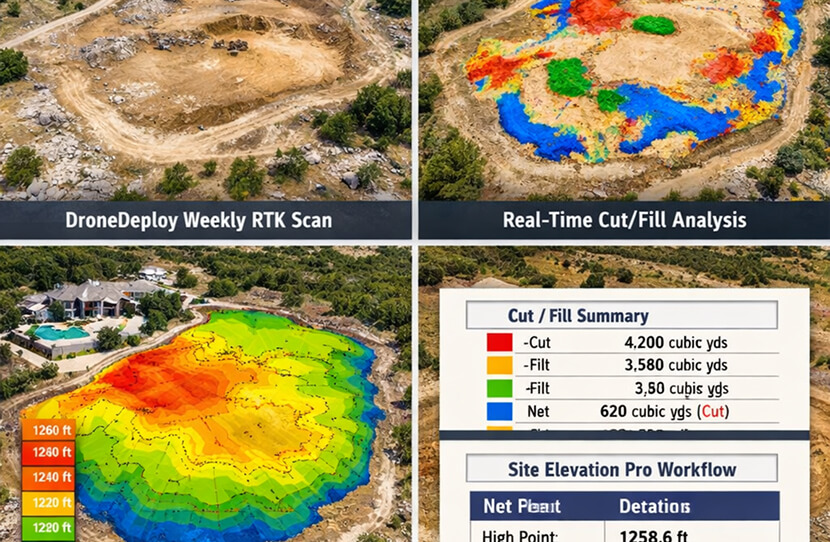
After each mowing visit, an RTK drone survey maps the cleared surface at the same accuracy as the pre-visit baseline. For ROW corridors, cleared corridor width is verified against the easement specification. For acreage maintenance, cleared area by zone is measured and documented against the invoice.
For ROW contracts, this post-visit scan is the compliance documentation — timestamped, georeferenced, accessible via shareable link. The record confirms vegetation clearance within the corridor dimensions required by the utility operator's maintenance spec. Available immediately after the visit, not weeks later.
Post-Visit RTK SurveyCorridor Width VerifiedCleared Acreage DocumentedInvoice-to-Scan MatchCompliance Record Generated
Every mowing visit produces a before/after 3D Digital Twin hosted on Pix4D Cloud and accessible via shareable web link. For recurring maintenance clients, each visit's scan is archived alongside prior visits — creating a chronological maintenance record that shows vegetation state at every visit date.
That archive has practical value: HOA boards can show maintenance history to homeowners or insurers; ROW operators can demonstrate vegetation compliance across their corridor portfolio; property owners have a documented record for any dispute, sale, or insurance adjustment that references land condition over time.
Before / After 3D Digital TwinShareable Pix4D Cloud LinkTimestamped Visit ArchiveRegrowth Delta for Next Visit
Phase 05
Next Visit Targeting
Regrowth Tracked. Next Visit Targeted From Data.
At the end of each visit, the post-visit scan becomes the baseline for the next. For annual maintenance contract clients, ClearGround can provide regrowth tracking between visits using periodic drone monitoring rather than waiting until the next scheduled mowing to discover what has come back.
For annual contracts, the prior-visit scan drives the mowing scope on the next visit: zones that haven't regrown don't get re-mowed; zones with measurable regrowth above the threshold get targeted passes. That scan-driven efficiency reduces unnecessary work and keeps the per-visit cost lower over a multi-year contract than blanket coverage each time.
Regrowth Baseline SetNext-Visit Scope Defined from DataMaintenance Contract SchedulingTargeted Passes Only
Annual contracts with documented visit records.
Complimentary Site Survey for Maintenance Contracts.
Qualifying annual forestry mowing contracts include a complimentary first-visit RTK survey — establishing the vegetation baseline, identifying regrowth zones, and setting the efficient scope for every subsequent visit. No obligation after the survey.
Every photo is from a real ClearGround job site. No stock. No renders.
Large-Area Forestry Mowing — Hill Country
CAT 299D3 XE — Light Brush Pass
ROW Corridor — Post-Mowing
Annual Maintenance — Before / After
Post-Visit RTK Survey
Annual Maintenance Programs
Three Maintenance Plan Structures
Recurring forestry mowing is most cost-effective under a structured annual plan. Plans determine visit frequency, scope documentation, and per-visit pricing — and build the scan archive that makes each subsequent visit more targeted and more efficient than the last.
Single Visit
Per-Visit
Annual or one-time mowing with standard documentation
Per Acre
Quoted after site survey · $800–$2,000/acre typical
Forestry Mowing is the most price-variable scope in the portfolio because pass speed is directly tied to vegetation density and species — which only the pre-visit site survey can accurately quantify. The ranges below reflect real project costs in the Austin and Texas Hill Country market.
Scope / Vegetation Type
Coverage Rate
Duration
2026 Range
Open Field & Light Brush — Annual Maintenance
3–5 acres / day
0.5–1 day
$1,600 – $2,200 / acre
Mixed Brush & Cedar Regrowth
1.5–3 acres / day
0.5–2 days
$1,800 – $2,400 / acre
Dense Brush & Thick Mesquite
0.75–1.5 acres / day
1–3 days
$2,200 – $2,900 / acre
ROW / Utility Corridor — Per Linear Mile
Corridor width dependent
Per scope
$1,500 – $3,500 / mile
Defensible Space Maintenance (Structure Zone)
Per property
0.5–1 day
$1,800 – $3,000 flat
Defensible Space Maintenance (Estate / HOA)
Per acreage
1–3 days
$2,500 – $6,500 flat
Annual Contract — Light Veg. (multi-year rate)
Full property
Per visit
Below single-visit pricing
All pricing includes veteran operators and all fuel and maintenance costs. Highlighted rows are the most common Forestry Mowing scopes. Annual contracts priced below single-visit rates. Properties with significant dense cedar requiring dedicated forest clearing passes will be quoted under Forest Clearing rates for those zones — the pre-visit survey identifies the zone breakdown.
Pre-Visit Vegetation Survey
Post-Visit RTK Verification Scan
Before / After 3D Digital Twin
Verified Acreage on Invoice
Veteran Operator + All Fuel
Zero Hauling or Burn Permits
Who This Is For
Forestry Mowing Clients
Forestry Mowing primarily serves recurring clients — land owners, HOAs, and utility operators who need vegetation managed over time, not just cleared once. The recurring relationship is where the data advantage compounds most significantly.
Primary Client
Estate & Ranch Owners
Hill Country estate and ranch owners who have done an initial clearing and need annual maintenance to prevent reversion. Cedar and Ashe Juniper regrowth from root crowns begins within a single growing season — annual mowing visits keep cleared land from becoming a full-clearing job again. The Digital Twin archive tracks property condition year over year.
Typical scenarios
Land cleared in a prior year showing cedar regrowth
Pastures and fields going weedy between seasons
Annual fire mitigation maintenance around structures
Wants documented maintenance history for insurance or resale
Hill Country HOAs and master-planned communities with undeveloped buffer zones, drainage easements, fire mitigation requirements, and common area maintenance obligations. Forestry Mowing provides the recurring scope, documented visit records, and consistent appearance that HOA management and insurance policies require.
Typical scenarios
HOA deed restrictions require annual vegetation maintenance on common areas
Insurance carrier requires documented fire mitigation maintenance
Buffer zones along boundaries encroaching on maintained areas
Community needs a single vendor for consistent annual scope
Utility companies, pipeline operators, county road departments, and land managers with recurring ROW vegetation maintenance obligations. Forestry Mowing with RTK verification provides the compliance documentation that ROW contracts require — corridor width verification, timestamped visit records, and a georeferenced maintenance archive.
Typical scenarios
Power line or pipeline corridor requiring annual vegetation clearance
County road shoulder maintenance contract
Utility easement maintenance with compliance documentation requirements
Multi-year ROW contract requiring verified visit records
The quote comes from a vegetation density map, not an estimate from the road. Light brush zones, heavier regrowth areas, ROW corridor dimensions, and terrain conditions are all captured before the machine is scheduled — so the price reflects the actual site.
Accurate Quoting
02
Scan-to-Scan Regrowth Targeting
Each maintenance visit is compared against the prior scan — so passes target zones where vegetation has actually regrown, not the whole property again. Over a multi-year contract, this efficiency improvement reduces unnecessary work and compounds in the client's favor each year.
Targeted Efficiency
03
Timestamped Visit Archive
Every visit produces a before/after Digital Twin added to the maintenance archive. The archive shows property vegetation state at every visit date — useful for insurance, resale, HOA reporting, utility compliance, or any dispute that references land condition over time.
Documented History
04
ROW Compliance Documentation Included
For ROW maintenance contracts, the post-visit RTK scan produces corridor width verification as a standard deliverable. The georeferenced documentation confirms clearance width was achieved within the easement spec and is available immediately after the visit for utility operator records.
ROW Compliance
05
Zero Hauling, Zero Burning
Material from every mowing visit is returned to the surface as chip-level mulch. No haul trucks, no burn permits, no secondary operations. On recurring annual visits, the accumulated mulch layer progressively improves soil health and moisture retention — which can slow the rate of regrowth over a multi-year maintenance program.
Zero-Waste
06
One Vendor Across the Full Spectrum
Forestry Mowing, Forest Clearing, Wildfire Mitigation, Fence Line Maintenance — all under one mobilization when properties need more than one scope in a visit. Annual maintenance clients whose properties escalate from mowing to clearing scope don't need to find a different contractor.
Single Vendor
FAQ
Forestry Mowing Questions Answered
What's the difference between Forestry Mowing and Forest Clearing?+
Forestry Mowing handles lighter, faster material — brush, cedar regrowth, field vegetation, and woody stems under approximately 4–5" diameter — at higher pass speeds and lower per-acre cost. It's the right scope for annual maintenance, overgrown fields, ROW corridors, and defensible space upkeep. Forest Clearing & Land Preparation is the comprehensive scope for dense cedar stands, mature canopy forest, and properties with significant 6"+ trunk diameter trees — slower passes, more machine hours per acre, and higher per-acre cost, but a complete transformation rather than a maintenance cycle. Forestry Mowing is commonly the annual follow-on service after an initial Forest Clearing job.
Will Forestry Mowing kill the cedar so it doesn't come back?+
No — and this is an important distinction. Forestry Mowing cuts and mulches above-grade material, but Ashe Juniper (Texas Cedar) is a well-documented resprouter from root crowns after cutting. Annual mowing will keep regrowth suppressed and the land open, but will not eliminate cedar permanently. Permanent elimination requires complete root extraction — which is the Tree Mulching & Root Extraction scope. Forestry Mowing is the efficient annual management tool for keeping cedar regrowth from becoming a full clearing job again, not a permanent solution. If permanent control is the goal, that conversation starts with the root extraction scope.
How does a multi-year maintenance contract work?+
Annual maintenance contracts are priced below single-visit rates and locked for the contract term — no price escalation on renewal. The first visit establishes the vegetation baseline scan. Each subsequent annual visit uses the prior scan to identify regrowth zones and target mowing passes accordingly, rather than blanket-covering the full property. Contracted clients receive priority scheduling — their annual visits are booked before new single-visit work in the same window. Multi-year contract pricing (2–3 year terms) carries the lowest per-visit cost in the portfolio.
What does ROW maintenance documentation include?+
Every ROW maintenance visit produces: a pre-visit vegetation survey identifying where regrowth has re-entered the corridor; a post-visit RTK drone survey confirming corridor width was cleared to the easement specification; a before/after 3D Digital Twin accessible via shareable link; a timestamped entry in the maintenance archive; and an invoice with verified cleared footage or acreage. The documentation package is designed to satisfy utility operator vegetation management compliance requirements. For operators with specific reporting formats, deliverable customization is available on multi-year contract scope.
What's the best time of year to schedule a mowing visit?+
Late summer through fall (August–November) is the optimal window for annual mowing in Central Texas — vegetation has peaked its growing season growth, conditions are typically drier than spring, and the cleared surface has maximum time to suppress new growth before the following spring. Spring visits (March–May) are the second common window, clearing winter regrowth before summer fire season. For defensible space maintenance, a pre-fire-season visit (April–May) aligned with NFPA Firewise guidance is recommended. ROW maintenance contracts are typically scheduled at the operator's compliance window rather than seasonal optimization.
Can Forestry Mowing and Fence Line Maintenance be combined in one visit?+
Yes — and combining scopes in a single mobilization is the most cost-effective approach for properties that need both. Fence Line & Perimeter Maintenance addresses the access corridor along fence lines and property boundaries; Forestry Mowing handles interior acreage maintenance. Both use the same equipment — CAT 299D3 XE with FAE head — and both are verified in the same post-visit RTK scan. Combined-scope visits are priced and quoted together after the site survey identifies what each zone of the property requires.
My property has a mix of light brush and dense cedar — how is that quoted?+
Mixed-density properties are quoted zone by zone after the pre-visit vegetation survey. The drone survey maps density by zone, and each zone is assigned the appropriate scope and rate — light brush zones at Forestry Mowing rates, dense cedar zones at Forest Clearing rates. The invoice reflects the actual zone breakdown from the scan. You're not paying Forest Clearing rates for zones that only need mowing, and the operator isn't running into dense mature cedar expecting to cover it at light-brush pass speeds.
Annual contracts. Scan-targeted visits. Documented every time.
Get a Forestry Mowing Quote
Whether it's a single maintenance visit, an annual contract, or a recurring ROW program — the quote starts with a vegetation survey. Tell us about your property and we'll map it before we price it.