


Forestry mulching is one of the most cost-effective ways to clear land — but pricing still varies more than most property owners expect. Understanding what drives the cost helps you budget accurately, compare quotes fairly, and avoid committing to a number that will change once work begins.
// In This Guide
// 01 Why Forestry Mulching Can't Be Priced Without a Site Visit
Forestry mulching cost depends almost entirely on what's on the land and how much of it there is. Vegetation density, terrain, tree size, and total acreage all affect how long the job takes — and time is what you're primarily paying for.
⚠ What This Means
Any quote given without an actual site visit is a guess. A contractor who prices your property over the phone is either leaving margin to cover the unknowns — or they'll add it to the invoice once the machine is already on your land. ClearGround's process starts with an RTK drone scan that gives us a fixed-price bid with no guesswork built in.
// 02 What Drives Forestry Mulching Cost
Five variables account for nearly all the price difference you'll see between properties of similar acreage. Here's how each one moves the number.
Acreage
Forestry mulching is primarily priced by the acre. More land means more time, which means higher cost. That said, larger properties sometimes see a lower per-acre rate — especially on open, accessible sites where the machine can move efficiently without stopping. Accessibility and terrain matter as much as raw acreage.
Vegetation Density and Type
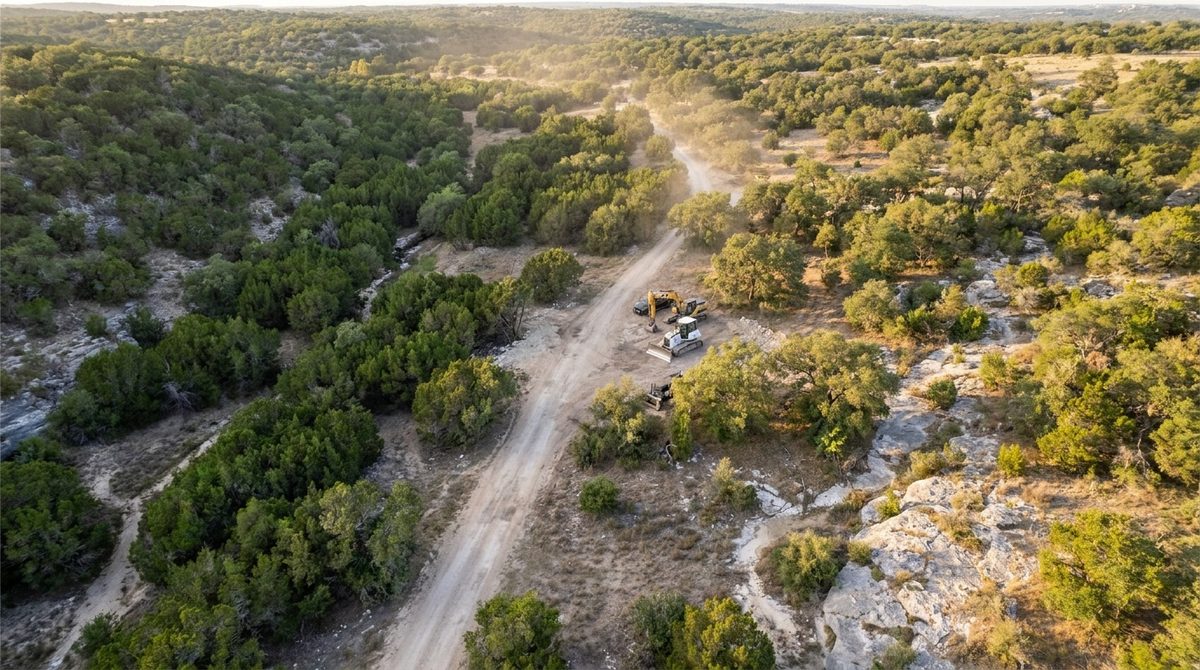
Light brush clears significantly faster than dense overgrowth with large trees and thick stumps. A property covered in heavy Hill Country cedar takes measurably more time per acre than one with young, light undergrowth — and that difference shows directly in the final cost. Mesquite with deep tap roots, mature live oaks, and hardwood stumps all slow the machine down.
Terrain and Site Conditions
Flat, open land is faster and easier to work than steep slopes, rocky limestone outcroppings, or wet ground. Difficult terrain slows the machine down and increases the time per acre. In Austin's Hill Country — where Balcones Escarpment terrain combines slopes with exposed limestone — this factor is frequently underestimated in off-the-cuff quotes.
Tree Size and Stump Density
Larger trees and heavy stump loads require more passes and more effort from the machine. A property with a high concentration of mature trees — especially ones at or near the diameter limit of the mulching head — will cost more per acre than one with smaller, younger growth. This is also where operator skill matters: working precisely around trees you want to keep takes more time than clearing everything.
Site Access
If the machine has difficulty getting onto the property — narrow entry points, soft ground, remote location, or a long haul from the road — expect to see that reflected in the quote. Mobilization cost is real, and difficult access adds time to setup, repositioning, and exit. Some remote Hill Country properties add a half-day to the job before the first pass is made.
// 03 Austin TX Cost Ranges by Site Type
These ranges reflect Austin and Hill Country market pricing. They're a starting framework — not a substitute for a site-specific assessment.
"We scan every property before we quote. You see the vegetation density, slope, and clearing zones in 3D before we give you a number — so the number we give you holds."
— ClearGround, Austin TX · Hill Country · Salt Lake City UT
// Interactive Tool
Forestry Mulching Cost Estimator
Get a rough ballpark based on your site. This is a starting point — not a quote. A site visit is required for accurate pricing.
// Estimated Project Range
// Estimates based on Austin TX and Hill Country market pricing. Actual cost depends on site-specific conditions. This tool is not a quote. An RTK site scan is required for accurate fixed-price bidding.
// 04 Forestry Mulching vs. Traditional Clearing: Which Costs Less?
For most residential and rural clearing projects, forestry mulching is the more cost-effective option. Here's why the comparison isn't as close as it might initially look.
Traditional clearing involves equipment costs, crew costs, debris hauling, disposal fees, and sometimes burn permits — all of which stack on top of each other. Forestry mulching eliminates every one of those line items. On anything larger than a small residential lot, the total cost comparison usually favors mulching by a meaningful margin.
Want to see the comparison for your specific property? We'll give you a site-specific estimate alongside a traditional clearing comparison — before you commit to anything.
Book a Free Site Scan →// 05 What a Good Forestry Mulching Quote Should Include
A thorough quote is a project plan in draft form. If something isn't specified in writing, you have no basis for a dispute when it becomes one.
Before You Sign — Quote Checklist
- Total acreage being cleared, specifically defined
- Vegetation type and density assessment — how the contractor evaluated your site
- Mobilization costs stated separately, if applicable
- Whether any follow-up grading or site work is included or priced separately
- Clear project timeline — start date, estimated completion
- How trees and vegetation to be preserved will be identified and protected
- What happens if unexpected conditions (rock, large stumps, wet ground) are encountered mid-job
- Whether mesquite or other tap-root species are present and how regrowth is addressed
A vague quote will change. If any item above is missing, ask for written clarification before signing.
// Frequently Asked Questions
How much does forestry mulching cost per acre in Austin TX?
In Austin and the Texas Hill Country, forestry mulching typically ranges from $1,500 to $5,000 per acre depending on vegetation density, terrain, tree size, and site access. Light residential brush runs toward the lower end. Heavy cedar with large stumps on steep Hill Country terrain runs toward the higher end or beyond. A site visit is required for accurate pricing.
Is forestry mulching cheaper than traditional land clearing?
For most residential and rural projects, yes. Traditional clearing stacks multiple cost layers on top of the clearing rate itself: multiple machines, multiple crews, debris haul-off, disposal fees, and sometimes burn permits. Forestry mulching eliminates all of those. The elimination of disposal costs alone often makes it the more cost-effective option on any project of meaningful size.
What should a forestry mulching quote include?
Total acreage, vegetation density assessment, mobilization costs if applicable, follow-up grading scope, a clear project timeline, and how preserved trees will be protected. If any of these are missing, ask for written clarification before signing.
Can I get a fixed-price quote for forestry mulching?
Yes — when the contractor has done a proper site assessment. ClearGround's RTK drone pre-scan maps vegetation density, slope, and drainage before we quote, which allows us to provide a fixed-price bid rather than an hourly estimate with an unknown total.
// Ready for a Real Number?
Scanned Before Quoted.
Fixed Price. No Surprises.
ClearGround provides free site assessments for forestry mulching projects across Austin, the Hill Country, and Salt Lake City. RTK scan included. Fixed-price bid delivered.
Book a Free Site ScanServing Austin, TX · Texas Hill Country · Salt Lake City, UT